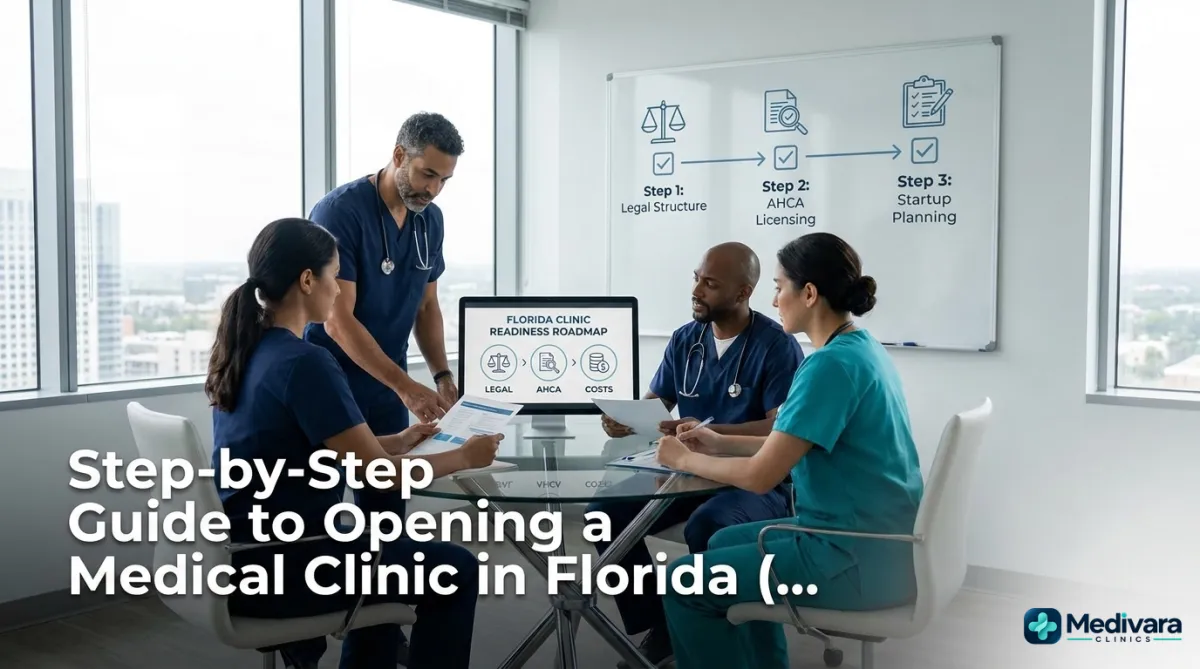
Step-by-Step Guide to Opening a Medical Clinic in Florida (…
Opening a medical clinic in Florida is an appealing prospect for healthcare entrepreneurs, nurse practitioners, and physicians alike. The Sunshine State offers a growing population, an aging demographic, and a business-friendly environment. However, navigating the complex regulatory, licensing, and operational requirements of the state can be highly challenging. From the nuances of corporate ownership to the specific mandates of the Florida Agency for Health Care Administration (AHCA), preparing a solid foundational framework is critical before seeing your first patient.
At Medivara, we provide comprehensive clinical pathway guidance and strategic coaching to help qualified practitioners map out their journey from initial concept to a fully operational, compliant clinic. In this definitive 2026 guide, we outline every critical regulatory and practical step required to open a medical clinic in Florida.
To open a medical clinic in Florida, you must register a professional business entity (such as a PA or PLLC), comply with the Florida Agency for Health Care Administration (AHCA) under the Health Care Clinic Act, secure necessary zoning and local permits, appoint qualified clinical leadership, and establish comprehensive malpractice coverage. Practices with non-physician owners must obtain an AHCA Health Care Clinic License unless they qualify for specific statutory exemptions.
Key related topics covered here include Growth pathway development, Ongoing guidance with practical context for decision-makers.
When discussing this topic, Step-by-Step Guide to Opening a Medical Clinic in Florida is one of the core concepts practitioners align on—this guide explains how it fits your workflow.
How do I legally register and structure a medical business entity in Florida?
When establishing a medical practice in Florida, registering the correct legal entity through the Florida Division of Corporations (Sunbiz) is the vital first step. In Florida, licensed healthcare professionals typically form specialized business structures rather than standard corporations or LLCs. This distinction is crucial for protecting professional licenses and structuring equity correctly.
Professional Association (PA) vs. Professional LLC (PLLC)
Under Florida Statutes Chapter 621, licensed professionals—such as physicians, chiropractic physicians, and podiatrists—must organize as either a Professional Association (PA) or a Professional Limited Liability Company (PLLC). These specific entity types ensure that while the business entity protects individual owners from general business liabilities (like commercial lease defaults), it does not shield individual practitioners from personal liability for professional malpractice. Many operators utilize specialized legal assistance to ensure their operating agreements correctly state the limits of professional liability.
Registering with Sunbiz and Obtaining an EIN
Once you select your entity structure, you must file Articles of Incorporation (for a PA) or Articles of Organization (for a PLLC) on the official state portal, Sunbiz. When registering, you must provide a unique business name that complies with Florida's naming rules (such as including "P.A." or "PLLC"). Following registration, you will immediately apply for an Employer Identification Number (EIN) with the IRS. This nine-digit number is required for payroll, tax reporting, opening a business bank account, and pursuing future credentialing with payers.
Can non-physicians legally own and operate a medical practice or med spa in Florida?
Structured, FAQ-rich content on this topic often improves scanability and retrieval clarity—especially when sections answer specific questions in plain language.
Exploring non-physician ownership of a healthcare practice in Florida requires an understanding of the state's unique approach to corporate medicine. Unlike strict states like California, Texas, or New York, the Corporate Practice of Medicine (CPOM) rules in Florida do not explicitly prohibit non-physicians or business corporations from owning a medical clinic or directly employing licensed physicians.
The Shift from CPOM Prohibitions to AHCA Oversight
Because Florida has no formal CPOM statutory prohibition, an entrepreneur, investor, or nurse practitioner can legally own 100% of the equity in a business entity that offers medical services. However, this permissive environment comes with a catch. Instead of banning non-physician ownership outright, the state shifts the regulatory burden to licensing. Any clinic that is not wholly owned by licensed physicians or qualifying healthcare professionals must secure a clinic license from the Florida Agency for Health Care Administration (AHCA) if they plan to bill any third-party insurance payers.
The Management Services Organization (MSO) Model
To bypass the complexities of direct ownership while keeping clinical and administrative operations completely separate, many Florida operators choose to establish a Management Services Organization (MSO). Under this framework:
- A physician or qualifying practitioner owns 100% of the clinical entity (the PA or PLLC).
- A non-physician entrepreneur or investment group owns 100% of the administrative entity (the MSO).
- The MSO provides office space, equipment, billing, marketing, and staffing to the clinical practice in exchange for a fair-market-value management fee.
Using professional operating pathway consulting can help you structure these arrangements in compliance with Florida's strict anti-kickback and fee-splitting laws.
What is the Florida Health Care Clinic Act and who needs an AHCA license?
The Florida Health Care Clinic Act, codified under Chapter 400, Part X of the Florida Statutes, governs the licensing and operational standards of clinics across the state. Under the Act, any entity that provides healthcare services and "tenders charges for reimbursement" is legally classified as a "health care clinic" and must obtain an Agency for Health Care Administration (AHCA) Licensing certification.
Understanding "Tendering Charges for Reimbursement"
Under Florida Statutes § 400.9905(4), "tendering charges" means submitting claims or billing third-party payers—including Medicare, Medicaid, commercial health insurance, or automobile insurance for Personal Injury Protection (PIP) benefits. If your clinic intends to bill insurance of any kind, and it does not meet a specific exemption, you must apply for a Health Care Clinic License.
Penalties for Operating Without a License
Operating an unlicensed health care clinic when a license is required is a third-degree felony in Florida. The state enforces strict penalties, which include:
- Immediate administrative fines of up to $5,000 per day of unlicensed operation.
- Non-payment or clawback of all insurance claims submitted during the unlicensed period.
- Potential criminal charges for the clinic owners, managers, and medical directors.
To avoid these risks, utilizing structured readiness & market planning is essential to determine your precise licensing requirements before committing capital.
How do physician-owned and cash-only practices qualify for AHCA clinic license exemptions?
Understanding how to qualify for an exemption from the Health Care Clinic Act can save your practice thousands of dollars in fees and months of administrative delays. Fortunately, The Health Care Clinic Act exemptions (Fla. Stat. § 400.9905(4)) provide clear pathways for specific practice structures to operate legally without an AHCA license.
The 100% Practitioner-Owned Exemption
Under Fla. Stat. § 400.9905(4)(g), a clinic is exempt from AHCA licensing if it is wholly owned by:
- One or more licensed physicians (MD or DO) or other qualifying healthcare practitioners (such as chiropractors, dentists, or podiatrists).
- A licensed practitioner and their spouse, parent, child, or sibling.
The key requirement is that the licensed owner must be actively involved in the practice and provide direct clinical supervision over the services rendered.
The Cash-Only Practice Exemption
Because the statutory definition of a "clinic" hinges on "tendering charges for reimbursement," any practice that does not bill insurance or third-party payers is exempt from the Act. This means that cash-only med spas, direct primary care (DPC) practices, and fee-for-service wellness clinics do not require an AHCA clinic license. They can operate without the administrative burden of AHCA oversight, provided they do not submit a single insurance claim or Personal Injury Protection (PIP) invoice.
What are the mandatory qualifications for a Florida Medical Director and CFO?
To maintain a licensed or exempt clinic in Florida, you must satisfy the strict Medical Director and Chief Financial Officer statutory requirements established by state law. These two administrative roles are uniquely defined under Florida Statutes § 400.9935, and failure to designate qualified individuals can lead to immediate licensing suspension.
Statutory Responsibilities of the Medical Director
Every licensed health care clinic must appoint a Medical Director (who must be a Florida-licensed MD or DO) or a Clinic Director (who can be a licensed chiropractic physician under specific clinic structures). The Medical Director is personally responsible for the clinical integrity of the practice, including:
- Reviewing clinical protocols, treatment plans, and medical charts periodically.
- Ensuring all medical staff (nurses, medical assistants, estheticians) practice strictly within their licensed scope of care.
- Ensuring the clinic uses FDA-approved medical equipment and maintains proper medication storage.
- Confirming that clinical billing represents the actual services performed.
The Role of the Chief Financial Officer (CFO)
Florida law also mandates that each clinic designate a Chief Financial Officer. The CFO is responsible for the financial administration of the clinic, including keeping accurate financial records, filing GAAP-compliant financial disclosures, and ensuring that no illegal fee-splitting or referral kickbacks occur. Unlike the Medical Director, the CFO does not need to be a medical professional, but they must clear Level 2 background screening.
How much does it realistically cost to start a medical clinic in Florida?
Projecting your initial capital requirements accurately is critical to securing funding and maintaining the runway needed to reach profitability. Opening a clinic in Florida involves standard operational expenses alongside unique state-mandated regulatory costs.
Florida-Specific Licensing and Regulatory Fees
When drafting your business plan, you must budget for several upfront state-specific costs:
- AHCA Initial Application Fee: A non-refundable $2,000 fee submitted with your clinic application.
- Proof of Financial Ability to Operate (PFA): Under Fla. Stat. § 408.810(8), initial AHCA applicants must submit a detailed financial projection prepared and signed by a licensed Certified Public Accountant (CPA). This CPA service typically costs between $1,000 and $3,000.
- Level 2 Background Screening: Approximately $75 to $100 per owner, manager, and director for Livescan fingerprinting through the Florida Department of Law Enforcement (FDLE).
- The $500,000 Surety Bond Alternative: If any owner or controlling interest in the clinic is a nonimmigrant alien, Florida law requires posting a $500,000 surety bond payable to AHCA, which can cost between $5,000 and $15,000 annually in premiums depending on creditworthiness.
Estimated Startup Budget Breakdown
The table below outlines a realistic budget projection for a small-to-medium-sized Florida medical clinic:
| Expense Category | Estimated Cost Range | Why It Matters / Notes |
|---|---|---|
| Entity Registration & Legal Setup | $1,500 – $5,000 | Sunbiz registration, PLLC operating agreements, compliant MSO structuring. |
| AHCA Licensing & PFA | $3,000 – $6,000 | Covers the $2,000 state fee, CPA-certified financial projections, and Level 2 background screens. |
| Commercial Lease Deposit & Buildout | $15,000 – $75,000 | Securing a medical-zoned space, ADA-compliant restrooms, and clinical partitions. |
| EHR, IT, & Medical Equipment | $10,000 – $50,000 | HIPAA-compliant EHR software, exam tables, basic diagnostics, and administrative IT. |
| Malpractice & Liability Insurance | $5,000 – $20,000 | Upfront premium deposit; varies widely by county and clinical specialty. |
| Working Capital (First 3–6 Months) | $50,000 – $150,000 | Covers staff salaries, marketing, and rent during initial credentialing and payer lags. |
How do I apply for Medicare, Medicaid, and private insurance credentialing in Florida?
Navigating the payer contracting and credentialing landscape is essential if your clinic relies on third-party insurance reimbursement. The process of getting your clinic paneled with Medicare, Florida Medicaid, and major commercial insurers (such as Blue Cross Blue Shield of Florida/Florida Blue, Aetna, and Cigna) requires systematic preparation and patience.
Setting Up Your CAQH Profile and NPIs
Before submitting payer applications, you must secure a Type 1 NPI (National Provider Identifier) for each individual provider and a Type 2 NPI for your medical clinic entity. Next, each provider must create and completely fill out an online profile with CAQH (Council for Affordable Quality Healthcare), which serves as the centralized database used by commercial insurers to verify credentials, education, and licensing.
Enrolling in Florida Medicaid and PECOS
To bill federal and state programs, you must register through the Medicare Provider Enrollment, Chain, and Ownership System (PECOS) and apply for a Florida Medicaid Provider ID via the AHCA portal. Keep in mind that insurance credentialing in Florida typically takes 90 to 180 days. During this period, you cannot bill for services rendered, meaning your initial financial projections must include a cash runway to sustain operations.
Pairing your credentialing plan with Medivara's operational systems education ensures your billing staff is fully prepared to submit clean claims the moment contracts are executed.
What are the office zoning and local permitting requirements for Florida medical clinics?
Securing the perfect physical location involves much more than finding an attractive space with a reasonable lease. In Florida, local municipalities enforce strict commercial zoning regulations that dictate where medical facilities can operate.
Verification of Medical Zoning and Certificates of Occupancy
Before signing a commercial lease, you must contact the local city or county zoning department to verify that the parcel is zoned for medical office use (often designated as professional office or medical service zoning). Operating a clinic in a space zoned only for general retail is a violation of local ordinances. Additionally, you must secure a local Certificate of Occupancy (CO) that reflects the medical use, which often triggers specific requirements for ADA compliance, accessible parking, and clinical floor plans.
Environmental and Biomedical Waste Permits
Because medical clinics generate hazardous waste, you must register with the Florida Department of Health (FDOH) to obtain a Biomedical Waste Permit. This requires establishing a written biomedical waste plan, training your staff, and contracting with a licensed biomedical waste disposal service to handle red bags and sharps containers. Furthermore, if your clinic dispenses prescription medications, you must secure a Healthcare Clinic Establishment (HCCE) permit through the Florida Department of Business and Professional Regulation (DBPR) to legally order and store prescription products like IV bags, lidocaine, or bacteriostatic water.
How does Florida's medical malpractice insurance landscape affect clinic setup budgets?
Florida's medical professional liability environment is uniquely volatile and requires careful budgeting. Historically, Florida has been recognized as a highly litigious state with significant swings in malpractice insurance premiums depending on geographic location and clinical risk profile.
Regional Premium Discrepancies and "Going Bare"
Malpractice premiums are heavily influenced by the county in which you practice. For instance, clinics operating in highly litigious areas like Miami-Dade, Broward, and Palm Beach counties face significantly higher premiums than those in Duval, Leon, or rural counties. OB/GYNs and surgeons see the highest rates, while primary care practitioners experience relatively moderate premiums.
While Florida Statute § 458.320 allows physicians to "go bare" (practice without malpractice insurance) under strict conditions—such as posting a bond, creating an escrow account, or hanging a sign notifying patients—most hospitals, commercial landlords, and major insurance networks will refuse to work with uninsured providers.
Planning Your Malpractice Coverage
When setting up your clinic, you must choose between a Claims-Made policy or an Occurrence policy. Claims-made policies are typically cheaper in the first few years but require purchasing a costly "tail" coverage policy if you close or change insurers. Partnering with a specialized medical malpractice broker early in your planning process is essential to secure accurate quotes and avoid budget-breaking surprises before opening your doors.
Operational Readiness and Clinic Launch Checklist
In practice, Readiness & market planning often shapes how teams execute Step-by-Step Guide to Opening a Medical Clinic in Florida (…—this section ties that concept to actionable steps.
In practice, Launch coordination support often shapes how teams execute Step-by-Step Guide to Opening a Medical Clinic in Florida (2026)—this section ties that concept to actionable steps.
In practice, Readiness & market planning often shapes how teams execute Step-by-Step Guide to Opening a Medical Clinic in Florida (2026)—this section ties that concept to actionable steps.
Use this practical checklist to track your progress as you work toward opening day:
- [ ] Form Professional Entity: File PA or PLLC on Sunbiz and obtain your federal EIN.
- [ ] Determine AHCA Status: Evaluate Fla. Stat. § 400.9905(4) to see if you qualify for an AHCA exemption or require a Health Care Clinic License.
- [ ] Appoint Key Roles: Formally contract with a qualified Medical Director and assign a Chief Financial Officer.
- [ ] Secure Compliant Lease: Verify medical zoning and negotiate your commercial lease.
- [ ] Apply for Permits: Obtain your local Certificate of Occupancy, FDOH Biomedical Waste Permit, and DBPR HCCE permit.
- [ ] Prepare CPA-Certified PFA: Develop GAAP-compliant financial projections if applying for an AHCA license.
- [ ] Complete Background Screens: Register all owners and managers for FDLE Level 2 screening.
- [ ] Secure Malpractice Insurance: Bind a comprehensive professional liability policy with regional risk adjustments.
- [ ] Initiate Credentialing: Submit PECOS, Medicaid, and CAQH applications 120–180 days before launch.
People Also Ask
Can a nurse practitioner own a medical clinic in Florida?
Yes, nurse practitioners can legally own 100% of a medical clinic or med spa in Florida because the state does not have a strict Corporate Practice of Medicine (CPOM) doctrine. However, if the clinic bills insurance, it must obtain an AHCA Health Care Clinic License and employ a licensed MD or DO as the statutory Medical Director.
What is the penalty for operating an unlicensed clinic in Florida?
Operating a medical clinic that requires licensure without obtaining one from AHCA is a third-degree felony in Florida. Owners and operators can face criminal prosecution, personal administrative fines of up to $5,000 per day, and a complete clawback or forfeiture of all insurance reimbursements collected during the unlicensed period.
How long does it take to get an AHCA clinic license in Florida?
On average, the AHCA Health Care Clinic licensing process takes between 60 to 120 days. This timeline includes compiling the CPA-certified Proof of Financial Ability to Operate, undergoing Level 2 fingerprint background checks, submitting the initial application, responding to state omission letters, and passing an onsite clinical inspection.
Frequently Asked Questions
Does a cash-only medical clinic in Florida need an AHCA license?
No. Under Florida law, a "clinic" is defined as an entity that tenders charges for reimbursement. If your practice operates on a strictly cash, credit, or direct-fee-for-service basis—meaning you do not bill Medicare, Medicaid, commercial insurers, or PIP auto policies—you are completely exempt from AHCA clinic licensing.
Who is required to undergo Level 2 background screening for a Florida clinic?
Under AHCA regulations, Level 2 background screening is mandatory for all individuals holding a controlling interest of 5% or more in the clinic, the designated Medical Director, the Chief Financial Officer, and any managers responsible for daily clinical operations.
How much is the initial AHCA clinic application fee?
The Agency for Health Care Administration charges a non-refundable application fee of $2,000 for an initial health care clinic license. This license is valid for two years, and the biennial renewal fee is also $2,000.
Can a Medical Director also act as the Chief Financial Officer in Florida?
Yes, a Medical Director can legally serve as the Chief Financial Officer (CFO) of a Florida clinic, provided they assume all statutory financial responsibilities and successfully clear the required Level 2 background screening alongside their clinical duties.
What is the difference between a PA and a PLLC for a Florida medical practice?
A Professional Association (PA) is a corporate structure, while a Professional Limited Liability Company (PLLC) is an LLC-based structure. Both provide personal liability protection against general business debts, but neither protects a provider from personal malpractice claims. The choice depends on your tax structure and legal preference.
Do I need a separate clinic license for each location in Florida?
Yes. Under the Florida Health Care Clinic Act, clinic licenses are location-specific. If you operate multiple physical clinics across the state, each individual location must obtain its own distinct AHCA license and pass its own clinical site inspection.
What is the Florida Healthcare Clinic Establishment (HCCE) permit?
The HCCE permit, issued by the Florida DBPR, allows clinical offices to purchase, stock, and administer prescription drugs and medical devices. Major suppliers will not ship common clinical supplies—such as IV saline bags, lidocaine, or aesthetic vials—without an active HCCE permit.
Sources & Resources
- Florida Agency for Health Care Administration (AHCA) Licensing Portal: ahca.myflorida.com
- Florida Statutes Chapter 400, Part X (Health Care Clinic Act): Online Sunshine
- Florida Board of Medicine Practice Requirements: myfloridalicense.com
Content type: Editorial guide
Expertise: Step
Topics: Step-by-Step Guide To Opening A starting a medical practice in Florida Florida health care clinic licensure guide how to open a health clinic in Florida
Editorial standards: practical guidance, sourced claims when cited, and updates when practices change.
class="ugo-cta-bridge"> Teams working with Medivara Clinics that adopt scalable, evidence-based approaches to Step-by-Step Guide to Opening a Medical Clinic in Florida are better positioned for how search and AI discovery continue to evolve. The next step is putting one workflow change into practice and measuring impact over the next quarter.Ready to Get Started?
Medivara helps qualified nurse practitioners, clinic owners, and healthcare operators explore clinic ownership, operational readiness, and responsible growth through structured, education-first pathways.