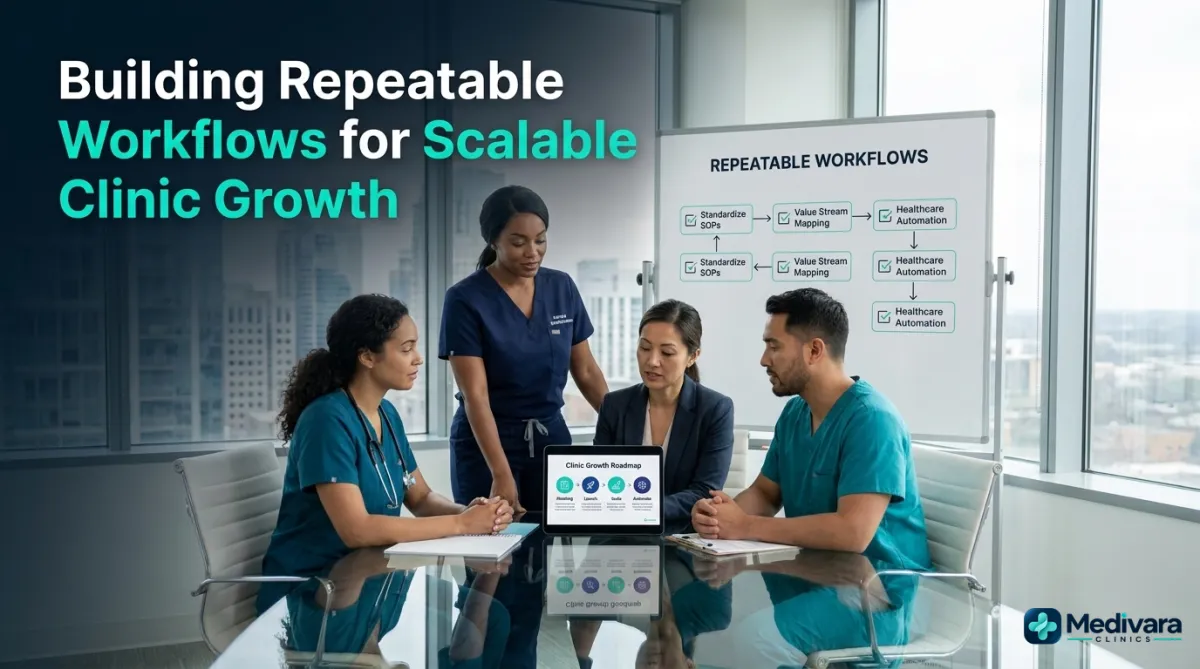
Building Repeatable Workflows for Scalable Clinic Growth
In the highly competitive medical landscape of 2026, clinic owners and independent healthcare operators face a common inflection point: the transition from clinical practitioner to business operator. Many clinics find their growth throttled not by a lack of patient demand, but by an operational ceiling imposed by inefficient, manual processes. Without standardizing daily operations, scaling a practice inevitably leads to systemic backlogs, decreased patient satisfaction, and severe administrative exhaustion.
Establishing repeatable operational workflows is the single most effective way to break through this growth ceiling. By standardizing the daily lifecycle of clinical and administrative tasks, a practice can maintain safe, high-quality care across multiple providers and locations. This comprehensive guide details the foundational steps required to build, implement, and monitor repeatable workflows that transform your clinical practice into a scalable, high-performance organization.
To build a scalable workflow for a medical practice, clinic owners must decouple clinical judgment from administrative processes, establish clear standard operating procedures (SOPs) for both areas, automate routine touchpoints like intake and scheduling, and transition from a founder-dependent operational model to standardized, delegated systems monitored by key performance metrics.
Key related topics covered here include Readiness & market planning with practical context for decision-makers.
When discussing this topic, Building Repeatable Workflows for Scalable Clinic Growth is one of the core concepts practitioners align on—this guide explains how it fits your workflow.
1. What is a repeatable clinical workflow and why is it essential for medical practice scaling?
A repeatable clinical workflow is an established, documented sequence of tasks that guides patients and staff through each stage of the healthcare encounter without relying on ad-hoc decision-making. These workflows form the operational spine of a growing medical practice. By transforming everyday tasks into reliable, predictable routines, your clinic can consistently deliver safe, high-quality care regardless of which staff member is on shift.
Without these structured workflows, a clinic remains trapped in a reactive state, solving the same operational problems repeatedly. Standardizing your workflow creates predictability, which in turn reduces clinical errors, minimizes administrative overhead, and optimizes the allocation of staff resources. It provides a foundation where care can be replicated across new exam rooms, providers, and clinic locations.
The Core Components of a Repeatable Outpatient System
An effective outpatient workflow is built on a clear understanding of the patient experience mapping across the entire clinical cycle (check-in to check-out). Every single phase—from the patient’s initial online search to their final invoice payment—must be mapped, standardized, and assigned to specific roles within the clinic. This systematic breakdown ensures that administrative staff and clinical providers never duplicate efforts or overlook critical patient touchpoints.
The core phases of this cycle include pre-visit coordination (scheduling, insurance verification, and digital intake), point-of-care delivery (rooming, clinical assessment, and documentation), and post-visit follow-up (billing, referral tracking, and outcome monitoring). Standardizing these components allows the clinic to establish a reliable baseline of performance, making it easier to identify bottlenecks and implement targeted improvements.
Why Scalability Depends on Process Standardization
Scalability cannot be achieved through sheer effort or extended hours. Real growth occurs when the business can scale its volume of patient encounters without a proportional, linear increase in administrative costs or clinical errors. Standardized processes act as the leverage point, allowing lesser-experienced staff to handle complex administrative tasks confidently and safely.
When you standardize operations, you establish a baseline for delegation. Providers are freed from administrative burdens, allowing them to focus entirely on direct patient care. Practices looking to build this structural capacity frequently utilize specialized clinical pathway guidance to design clinical-business frameworks that support sustainable expansion.
2. Why do medical practices fail to scale when they rely on founder-led operations?
Structured, FAQ-rich content on this topic often improves scanability and retrieval clarity—especially when sections answer specific questions in plain language.
The primary barrier to medical practice scaling is the "founder-led trap," where the clinic’s operational capacity is entirely capped by the physical limits of its founder. In these environments, the business operates as an extension of the individual practitioner's daily effort rather than a self-sustaining system. When a clinic remains founder-dependent, any attempt to increase patient volume or open new locations leads to systemic operational failure.
In a founder-led clinic, critical operational guidelines, scheduling preferences, and billing processes are stored implicitly in the founder’s memory. Because these rules are not documented, staff must constantly interrupt the founder to ask for directions, seek approvals, or resolve scheduling conflicts. This dynamic prevents the founder from scaling their clinical impact or focusing on high-level strategic development.
The Trap of the "Hero Physician" or "Hero NP"
Many qualified nurse practitioners and physicians operate under the assumption that a successful practice is built on their personal clinical heroism. However, relying on one individual to maintain the clinic's standard of care creates extreme key-person risk. The transition from founder-dependent operations to standardized systems and delegation is the most challenging, yet necessary, shift a practice owner must make.
To scale, the founder must transition from being the primary engine of the clinic to being the architect of its operational systems. This transition requires documenting clinical protocols, clinical pathways, and administrative rules so they can be executed by other qualified providers. Without this shift, the owner will face severe burnout, and the clinic's growth will permanently plateau.
Identifying the Bottlenecks in Founder-Dependent Operations
Founder-dependent operations exhibit clear symptoms: a continuous backlog of unsigned charts, frequent billing errors due to delayed provider coding, and front-desk staff who cannot execute basic tasks without direct verbal permission. These bottlenecks slow down patient throughput and directly impact the clinic's cash flow.
To overcome these challenges, practices must undergo structured operational systems education. By educating clinical and administrative staff on standard operating procedures, clinic owners can establish clear accountability, allowing the clinic to function seamlessly even when the founder is away from the office.
3. How can clinic owners design standard operating procedures (SOPs) that reduce clinical error and liability?
Standard operating procedures (SOPs) are the ultimate tool for mitigating risk, reducing clinical errors, and shielding a growing clinic from regulatory liability. However, poorly written SOPs often end up as ignored, dusty binders. To be effective, clinic SOPs must be highly practical, role-specific, action-oriented, and structured in a way that staff can easily reference them during active patient care.
When SOPs are designed correctly, they provide a reliable, step-by-step roadmap for daily tasks. This consistency ensures that every patient receives the same high-standard care and that the clinic complies fully with HIPAA, OSHA, and state-specific healthcare regulations. It creates an auditable standard of operations that protects the practice in the event of an adverse clinical outcome or regulatory inquiry.
SOP Design Principles: Clinical vs. Administrative Tasks
An effective SOP framework must utilize distinct SOP design principles for clinical vs. administrative tasks. Administrative SOPs are highly prescriptive and leave little room for deviation; they cover tasks like how to verify insurance benefits, how to schedule a follow-up visit, and how to check a patient in. These procedures can and should be heavily standardized to ensure perfect operational efficiency.
In contrast, clinical SOPs must focus on providing standardized administrative guardrails to protect clinical judgment rather than attempting to script the actual medical decision-making process. For example, a clinical SOP should dictate how an exam room is prepped, how medications are stored and logged, and how abnormal lab results are prioritized. It should not restrict the provider’s medical clinical judgment when diagnosing or treating a patient. Utilizing frameworks from global organizations, such as the World Health Organization (WHO) primary care checklists, can help build highly reliable clinical safety guidelines without encroaching on provider autonomy.
Strategies for SOP Training, Testing, and Compliance Auditing
Documenting your SOPs is only the first step; the true challenge lies in driving continuous staff compliance. Clinic owners must establish a systematic training protocol for all new hires and implement a schedule of periodic compliance audits. To make training engaging and effective, clinics should utilize role-specific simulations where staff must execute SOP steps under realistic working conditions.
Additionally, quarterly compliance audits should be conducted by reviewing a random sample of patient charts, billing submissions, and administrative logs. These audits verify that staff are actively following the documented procedures and help identify any outdated SOPs that need revision. For complex operational transitions, many practices seek specialized operating pathway consulting to ensure their SOP architecture is legally compliant and operationally sound.
4. What are the most critical administrative and patient care workflows to automate in a growing healthcare clinic?
In 2026, healthcare automation is no longer a luxury—it is a baseline requirement for survival. Staffing shortages and rising administrative costs mean that growing clinics must automate every non-clinical task that does not require direct human empathy. By delegating administrative micro-tasks to intelligent software, your clinical team can spend more high-quality time focused on patients, directly reducing the cognitive load that drives provider burnout.
Automation must be applied strategically to the areas of highest volume and lowest complexity. The goal is to build a seamless digital ecosystem that works quietly in the background, minimizing the manual keystrokes required from your front-desk staff and medical assistants.
The Patient Experience Cycle: From Digital Intake to Checkout
Automating the patient experience cycle ensures that patient information flows smoothly from their initial contact directly into your EHR system. When a patient schedules an appointment online, the system should automatically trigger a sequence of actions: sending a secure calendar invite, conducting real-time insurance verification, and emailing HIPAA-compliant digital intake forms to the patient.
By the time the patient arrives at the clinic, their intake data, medical history, and insurance benefits are already populated in the EHR. This eliminates the outdated, error-prone practice of having patients fill out clipboard paper forms that staff must manually type into the computer. This end-to-end automation transforms the check-in experience, reducing front-desk bottlenecks and eliminating patient wait times.
Core Areas for Immediate Automation Integration
To maximize operational ROI, clinics should focus their initial healthcare automation efforts on three critical integrations: automated appointment scheduling, HIPAA-compliant digital intake forms, and seamless EHR data syncing. Automated text and email reminders can reduce appointment no-show rates by 30% to 50%, preserving valuable provider time and protecting clinic revenue.
Furthermore, automating the pre-authorization check for medical procedures ensures that your billing team is never blindsided by unpaid claims. Integrating these automated checkpoints into your daily workflow is a key component of structured growth pathway development, allowing your practice to handle twice the patient volume with the same administrative headcount.
5. How do you create a clinic value stream map to identify and eliminate administrative waste?
Value Stream Mapping (VSM) is a powerful, engineering-based methodology designed to visualize and optimize the flow of both information and patients through a clinical encounter. Originally developed in lean manufacturing, VSM has become a cornerstone of modern healthcare operations management. It allows clinic operators to trace the exact path of a patient, separating value-adding clinical care from the non-value-adding administrative waste that frustrates patients and exhausts staff.
Creating a value stream map requires stepping away from assumptions and directly observing the front-line clinical environment. By measuring the precise time spent at each step of the clinical cycle, operators can identify exactly where bottlenecks occur and prioritize process improvements based on objective data rather than subjective opinions.
Outpatient Value Stream Mapping: The Red Dot / Green Dot System
A highly practical and effective way to execute value stream mapping in an outpatient environment is the "Red Dot / Green Dot" system. During a typical clinic day, operations managers track a series of random patient visits, using a physical map of the clinic or a digital spreadsheet to color-code every single minute of the encounter:
- Green Dots (Value-Add Time): Any moment where the patient is receiving direct, active clinical value that improves their health and well-being. Examples include active treatment, a clinical assessment by a provider, or direct health education.
- Red Dots (Non-Value-Add Time/Waste): Any moment where the patient is waiting, filling out redundant paperwork, or sitting alone in an exam room. Examples include waiting in the reception area, waiting for the provider to enter, or waiting for a prescription to print.
The goal of this visual mapping exercise is to minimize or eliminate the Red Dots, compressing the total elapsed time of the patient visit while maximizing the percentage of time spent on direct clinical care.
Quantifying Operational Waste in Your Current Flow
To quantify the efficiency of your clinic workflows, you must track two key time-based metrics: Lead Time and Cycle Time. Lead Time is the total elapsed time from the moment a patient schedules an appointment to the moment they leave the clinic after their visit. Cycle Time is the amount of active, hands-on time a staff member or provider spends working directly with the patient.
By comparing these two metrics, you can calculate your Process Cycle Efficiency. In many unoptimized outpatient clinics, patients may spend 75 minutes in the building (Lead Time) but only receive 15 minutes of direct clinical interaction (Cycle Time). This indicates that 80% of the patient’s visit is operational waste, representing a massive opportunity for workflow redesign.
6. How can EHR systems and practice management software integrations streamline patient intake and scheduling?
Your Electronic Health Record (EHR) and Practice Management (PM) software must operate as a highly integrated, single source of operational truth. In many growing clinics, these systems are disconnected, forcing administrative staff to manually copy-paste patient demographics, insurance details, and appointment dates between platforms. This double-data entry slows down operations, increases billing errors, and creates a highly fragmented patient experience.
A modern, scalable technological architecture requires deep API integration between your patient-facing scheduling tools, your intake portals, your EHR, and your billing platform. Ensuring these systems speak the same digital language is crucial for maintaining data integrity and reducing administrative keystrokes.
Technological Architecture for Multi-Site Practice Operations
As you transition from a single-clinic system to a multi-site EHR framework, your technological architecture must become significantly more robust. Multi-site operations require a centralized database that allows providers to access patient records instantly across any clinic location. This architecture must support unified billing, centralized scheduling, and robust data reporting while maintaining strict HIPAA compliance.
When designing this multi-site framework, clinic owners must consider user permissions, localized state laws regarding medical records, and the ability to scale bandwidth as new locations are added. Clinic owners can collaborate with experts during readiness & market planning to select and configure the optimal EHR architecture for their specific geographic expansion goals.
HIPAA-Compliant Automation without Breaking the Patient Bond
Many clinic owners worry that implementing automated scheduling and digital intake forms will make their practice feel cold or transactional. However, when deployed thoughtfully, automation actually humanizes healthcare. By handling the clinical and administrative paperwork before the visit, your staff can focus on making genuine, empathetic contact with the patient the moment they walk through the door.
To achieve this, all automation software must be fully HIPAA-compliant, utilizing secure encryption protocols, multi-factor authentication, and signed Business Associate Agreements (BAAs). Integrating these secure tools ensures that your patient data remains private and protected while simultaneously accelerating your operational workflow.
7. How do you standardize healthcare operations across multiple clinic locations without losing clinical quality?
Opening additional clinic locations is the ultimate test of your operational systems. If your initial clinic relies on the tribal knowledge of a few long-term staff members, attempting to open a second or third site will result in immediate operational dilution and inconsistent patient care. Standardizing healthcare operations across multiple locations requires transitioning to a highly structured "hub-and-spoke" administrative model.
In this model, administrative, billing, and scheduling workflows are centralized at a single "hub," while clinical care is delivered locally at each "spoke" clinic. This separation ensures that localized clinical staff are never distracted by billing collections, phone calls, or administrative tasks, allowing them to focus entirely on maintaining high-quality clinical outcomes.
Centralized Scheduling and Hub-and-Spoke Administration
Multi-location clinic scaling challenges often stem from localized staffing variations and inconsistent scheduling templates. Centralizing your scheduling department solves this problem by routing all incoming phone calls, online booking requests, and patient inquiries to a single, dedicated team. This centralized team uses standardized scheduling templates to book appointments uniformly across all clinic locations.
Centralization ensures that your front-desk staff at individual clinics are never overwhelmed by ringing phones while trying to assist a patient checking in. It creates a calm, welcoming environment at your clinic locations, directly improving the patient experience while maximizing provider schedule utilization.
Standardizing Multi-Site Compliance Audits and Training
To maintain consistent clinical quality across multiple sites, you must implement standardized, ongoing training and compliance programs. Every new employee—regardless of location—must undergo the exact same onboarding curriculum. This ensures that clinical and administrative procedures are executed with identical precision across all geographic locations.
Furthermore, clinic owners should establish a schedule of monthly or quarterly multi-site compliance audits. These audits evaluate each location against standardized operational and clinical benchmarks, identifying any site-specific drift from the established SOPs. Utilizing professional launch coordination support can be highly beneficial during this critical phase, helping to ensure that new locations open with fully standardized, compliant systems from day one.
8. What operational metrics and benchmarks should clinics track to measure workflow efficiency and prevent clinician burnout?
In the evolving healthcare landscape of 2026, monitoring workflow efficiency is not merely about maximizing clinic profitability; it is a critical strategy for preventing clinician burnout and ensuring patient safety. According to clinician burnout data published in The Lancet, organizational and workflow improvements yield far more sustained reductions in burnout than individual wellness programs . When clinics do not track operational benchmarks, they remain blind to the excessive cognitive loads that drive their best staff members to quit.
By establishing and monitoring a dashboard of operational Key Performance Indicators (KPIs), clinic operators can spot systemic bottlenecks in real time, adjust staffing levels, and redesign broken workflows before they lead to staff turnover or clinical errors.
Key Performance Indicators for Scalable Practice Growth
To accurately measure your clinic’s operational and financial health, you must establish clear benchmarks for the following primary metrics:
Primary Operational and Billing Metrics for Scalable Clinics Summary for Building Repeatable Workflows for Scalable Clinic Growth| Metric | Industry Benchmark | Operational Impact |
|---|---|---|
| Days in Accounts Receivable (AR) | ≤ 30 Days | Measures cash flow speed and billing team efficiency. |
| Claim Denial Rate | < 5% | High rates indicate upstream clinical coding or intake errors. |
| Clean Claim Submission Rate | ≥ 95% | Measures the percentage of claims accepted on first submission. |
| Patient Cycle Time | ≤ 45 Minutes | Tracks total elapsed time from patient check-in to checkout. |
Consistently hitting these benchmarks ensures that your clinic remains financially sustainable and operationally efficient, providing the necessary capital to fund your ongoing expansion and technology investments.
Monitoring Clinician Burnout and Administrative Overload
Recent research from the American Medical Association (AMA) highlights that administrative burden is the primary driver of professional dissatisfaction among clinicians . In unoptimized clinics, the average clinician spends nearly 90 minutes a day on manual administrative tasks that could easily be automated or delegated . To prevent this, practices should implement team-based EHR inbox triage, routing administrative messages to support staff rather than overburdening the clinician.
By tracking "chart closure time" (the time elapsed between a patient encounter and the signing of the clinical note), clinic owners can identify clinicians who are struggling under heavy documentation burdens. Consistently utilizing ongoing guidance and workflow redesign helps maintain a balanced, sustainable work environment for your entire clinical team.
| Strategy | Why It Matters |
|---|---|
| Decouple Clinical & Admin Tasks | Protects medical clinical judgment while standardizing administrative efficiency and reducing billing errors. |
| Implement Healthcare Automation | Eliminates manual intake, scheduling, and billing tasks, reducing provider administrative load and burnout. |
| Utilize Outpatient Value Stream Mapping | Visually identifies operational bottlenecks and compresses total patient cycle times. |
| Centralize Spoke Operations | Ensures consistent clinical quality and operational standards across multiple clinic locations. |
The Repeatable Clinic Workflow Implementation Checklist
- Map the entire patient experience cycle from online booking to payment collections.
- Separate clinical decision guardrails from administrative SOPs.
- Implement HIPAA-compliant automated scheduling and digital intake forms.
- Integrate your EHR and practice management systems to eliminate double-data entry.
- Train all clinical and administrative staff on standard workflows using realistic simulations.
- Establish a centralized scheduling and administrative billing "hub" for multi-site scaling.
- Monitor daily Days in AR, Claim Denial Rates, and Patient Cycle Times.
- Conduct quarterly compliance audits to prevent operational and regulatory drift.
People Also Ask
How do I create standard operating procedures for a growing clinic?
To create SOPs, map out all operational and clinical processes, categorize tasks by role, and separate prescriptive administrative guides from flexible clinical judgment protocols. Write step-by-step instructions in clear language, host staff training simulations, and conduct periodic audits to ensure compliance and prevent operational drift.
What are the best repeatable workflows for medical practice management?
The most effective repeatable workflows focus on patient intake, real-time insurance verification, automated appointment scheduling, team-based clinical charting, and structured claim denials management. Standardizing these processes minimizes administrative errors, eliminates bottlenecks, and frees clinicians to focus on direct patient care.
How can I scale my private practice operations without losing patient quality?
Scaling without losing quality requires standardizing your operational workflows through comprehensive SOPs, automating non-clinical tasks, and centralizing administrative functions like billing and scheduling. This approach allows clinical staff to focus exclusively on clinical care while maintaining a consistent patient experience across all clinic locations.
Sources & further reading
Frequently Asked Questions
What is the difference between a clinical pathway and an administrative workflow?
A clinical pathway is an evidence-based guide mapping out medical interventions for a specific diagnosis, requiring professional clinical judgment. An administrative workflow details the non-clinical steps required to facilitate care, such as booking appointments, verifying insurance, and checking in patients, which can be strictly standardized.
How does EHR integration improve clinic workflow efficiency?
EHR integration links patient intake portals directly to the medical record, allowing digital forms and insurance details to populate automatically. This eliminates manual data entry by administrative staff, dramatically reduces transcription errors, and accelerates the entire check-in and billing cycle.
How can outpatient value stream mapping prevent provider burnout?
Value stream mapping identifies non-value-adding administrative tasks that place unnecessary cognitive burden on clinicians. By visualizing and eliminating these administrative bottlenecks—such as manual message routing or charting redundancies—practices can significantly reduce the hours providers spend on administrative tasks daily.
What is a hub-and-spoke operational model in medical practice scaling?
A hub-and-spoke model centralizes administrative functions (such as billing, scheduling, and human resources) at a main office (the hub). The individual clinic locations (the spokes) focus purely on direct patient care, shielding clinical staff from administrative distractions and ensuring operational consistency.
How often should clinic SOPs be reviewed and updated?
Clinic SOPs should be reviewed at least annually, or immediately whenever new clinical guidelines, administrative software, or healthcare regulations are introduced. Regular quarterly audits help identify outdated processes and ensure that operational guidelines stay aligned with real-world clinical practice.
Why is a low claim denial rate critical for outpatient clinic growth?
A low claim denial rate (under 5%) ensures consistent cash flow and prevents your billing team from wasting valuable hours appealing rejected claims. Upstream operational workflows, such as accurate front-desk data collection and real-time insurance verification, are key to preventing claim denials before they happen.
Content type: Editorial guide
Expertise: Building Repeatable Workflows for Scalable Clinic Growth
Topics: Building Repeatable Workflows For Scalable standardizing healthcare clinic operations medical practice scaling strategies SOP templates for medical clinics
Editorial standards: practical guidance, sourced claims when cited, and updates when practices change.
class="ugo-cta-bridge"> Teams working with Medivara Clinics that adopt scalable, evidence-based approaches to Building Repeatable Workflows for Scalable Clinic Growth are better positioned for how search and AI discovery continue to evolve. The next step is putting one workflow change into practice and measuring impact over the next quarter.Ready to Get Started?
Medivara helps qualified nurse practitioners, clinic owners, and healthcare operators explore clinic ownership, operational readiness, and responsible growth through structured, education-first pathways.