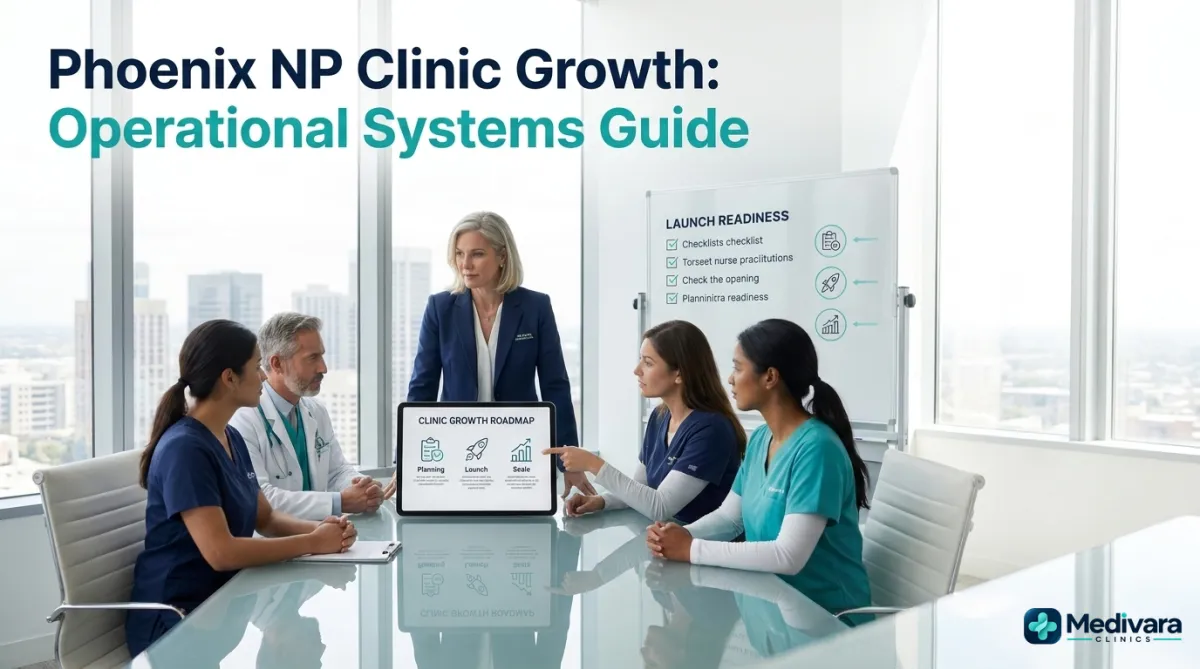
Phoenix NP Clinic Growth: Operational Systems Guide
Opening a clinical practice is one of the most empowering milestones in a nurse practitioner's career. In Arizona—a state recognized for granting full-practice authority to advanced practice registered nurses (APRNs)—the barriers to clinical entry are lower than in many other parts of the United States. However, the transition from clinical master to operational architect is often fraught with unexpected friction. Many highly qualified nurse practitioners who explore clinic ownership in the competitive Phoenix–Scottsdale corridor find that diagnosing patients is simple compared to diagnosing a broken administrative workflow.
Operational systems and repeatable workflows around an existing clinic — the structured clinical, administrative, and financial playbooks that allow a healthcare practice to run consistently and scale without relying entirely on the physical presence of the owner — are best established through structured growth pathway development. For qualified nurse practitioners in the Phoenix–Scottsdale area, this means shifting from clinical delivery to compliance-aligned business systemization.
Key related topics covered here include Readiness & market planning with practical context for decision-makers.
Key related topics covered here include Readiness & market planning, Launch coordination support, Ongoing guidance, especially operational systems and repeatable workflows around an existing clinic, with practical context for decision-makers.
Without structured systems, a clinic operates in constant firefighting mode. Front desk errors lead to billing delays, clinical documentation backlogs keep providers working long past closing time, and patient satisfaction suffers in the highly demanding Scottsdale market. Medivara Clinics serves as an education-first, strategic gateway to help healthcare operators build the operational runway needed to move from chaos to consistent, structured growth.
Key Aspect 1: Struggling to build operational systems and repeatable workflows around an existing clinic — how Primary: qualified nurse practitioners exploring clinic ownership in Phoenix–Sco in Scottsdale, AZ solve it with better growth pathway development Essentials
The Systemization Deficit in Modern Clinical Practice
Nurse practitioners receive some of the most rigorous clinical training in the healthcare industry. They are taught how to perform complex physical assessments, formulate differential diagnoses, and manage chronic diseases. However, very few nursing or graduate-level programs teach the fundamentals of workflow design, queue management, or supply chain systemization. This lack of structured operational education creates a standard bottleneck when a nurse practitioner transitions into practice ownership.
When operational systems are absent, a clinic relies heavily on individual heroics rather than repeatable processes. If a key medical assistant is out sick, the entire intake process grinds to a halt. If the owner-NP is busy managing patient charts, basic practice administration falls by the wayside. Solving this bottleneck requires moving away from ad-hoc task completion and toward designing workflows that anyone on the team can execute with identical precision.
Transitioning from Provider to Practice Architect
Solving the systemization challenge begins with a cognitive shift. The owner must stop viewing themselves strictly as the primary provider and begin viewing themselves as the architect of the practice. By focusing on growth pathway development, Scottsdale-based NPs learn to document their clinical and administrative processes. This educational approach ensures that every repeatable activity—from answering the initial phone call to submitting an insurance claim or processing a cash payment—is recorded in a centralized playbook.
Key Aspect 2: Struggling to build operational systems and repeatable workflows around an existing clinic — how Primary: qualified nurse practitioners exploring clinic ownership in Phoenix–Sco in Scottsdale, AZ solve it with better growth pathway development Essentials
Structured, FAQ-rich content on operational systems and repeatable workflows around an existing clinic often improves scanability and retrieval clarity—especially when sections answer specific questions in plain language.
Leveraging Full Practice Authority Legally and Structurally
In Arizona, the Arizona State Board of Nursing (AZBN) grants full practice authority, allowing nurse practitioners to evaluate, diagnose, initiate treatments, and prescribe medications without a collaborative agreement with a physician. While this legal autonomy is highly beneficial, it also means the NP bears absolute responsibility for all compliance, liability, and quality controls within the facility. This responsibility makes operational compliance systems non-negotiable.
Under Arizona Revised Statutes (A.R.S.) Title 32, Chapter 15, NPs must maintain strict standards of professional conduct and documentation. A lack of standardized charting systems or failure to implement structured clinical audit pathways can jeopardize your license. Growth pathway development focuses on building these regulatory guardrails directly into your daily EHR and clinical workflows, ensuring that compliance is an automated byproduct of your operations rather than an afterthought.
The Phoenix-Scottsdale Business Entity Framework
Setting up the correct business structure is a critical early step. In Arizona, professionals licensed by state boards must typically organize as a Professional Limited Liability Company (PLLC) rather than a standard LLC. When establishing a PLLC in Maricopa County, the operating agreement must explicitly outline clinical decision-making hierarchies. Standard business operating systems must be designed to respect these corporate-practice-of-medicine realities, ensuring that administrative partners do not cross the boundary into clinical delegation.
Key Aspect 3: Struggling to build operational systems and repeatable workflows around an existing clinic — how Primary: qualified nurse practitioners exploring clinic ownership in Phoenix–Sco in Scottsdale, AZ solve it with better growth pathway development Essentials
Mapping the Patient Intake and EHR Workflow
The patient's journey through your clinic is the ultimate test of your operational design. In many newly owned Scottsdale clinics, patients wait too long in the lobby, fill out redundant paperwork, and experience disjointed transitions between the front desk and the treatment room. A standardized workflow eliminates these friction points by defining exact actions, triggers, and time limits for every phase of the visit.
To build a repeatable intake system, consider utilizing digital pre-registration tools integrated directly with your Electronic Health Record (EHR). Patients should complete intake forms, upload identification, and sign consent forms before setting foot in the clinic. When the patient arrives, the front desk workflow is simplified to checking a photo ID and verifying that the digital file is complete, drastically reducing lobby bottlenecking.
Clinical Workflow Transformation: Unsystemized vs. Systemized Summary for Phoenix NP Clinic Growth: Operational Systems Guide| Operational Phase | Unsystemized Practice (The Bottle-neck) | Systemized Pathway (The Growth Model) |
|---|---|---|
| Patient Intake | Paper forms on clipboard; manual data entry by MA while patient waits. | Automated digital pre-registration; auto-populated EHR profiles. |
| Clinical Charting | NP drafts notes from scratch late at night; missing compliance elements. | Structured, template-driven EHR charts completed during or immediately after the visit. |
| Billing & Coding | Paper billing sheets compiled weekly; high rate of coding rejection. | Real-time billing code triggers built into EHR clinical workflows; clean claim verification. |
EHR Template Standardization for NPs
Another major operational issue is "charting debt." Nurse practitioners often spend hours charting after-hours because their EHR templates are either too complex or entirely non-existent. Growth pathway systems guide owners in building clinical templates aligned with their specific practice focus (e.g., family medicine, medical weight loss, hormone replacement therapy, or aesthetics). By designing templates that utilize logic-based checkboxes and compliant default text, providers can complete their notes in real-time, leaving the clinic with a clean slate every evening.
Key Aspect 4: Struggling to build operational systems and repeatable workflows around an existing clinic — how Primary: qualified nurse practitioners exploring clinic ownership in Phoenix–Sco in Scottsdale, AZ solve it with better growth pathway development Essentials
What is Growth Pathway Development?
Growth pathway development is a strategic methodology that sequences business scaling milestones in a logical, low-risk order. Rather than pouring money into marketing or signing expensive commercial leases in North Scottsdale before your operational systems are stable, growth pathway development insists on proving your concept, documenting your workflows, and optimizing your unit economics first. This education-first pathway reduces the operational stress and capital risk that sinks many healthcare startups.
Through Medivara's structured approach, nurse practitioners receive clear clinical pathway guidance. This guidance is designed to clarify your target patient demographic, map out regulatory compliance, and determine exactly how many patients your daily workflows can support without compromising care. By matching operational capacity with market demand, you build a clinic that scales naturally and responsibly.
Analyzing the Scottsdale Healthcare Demographics
Scottsdale, Arizona, represents a unique clinical market. The local population is highly health-conscious, affluent, and has high expectations for customer service, convenience, and clinic aesthetics. Whether your practice is located in the master-planned communities of North Scottsdale or the trendy districts of Old Town, your operational workflows must match these consumer expectations. Your systems should support online self-scheduling, seamless texting communication, and clear, transparent pricing models for cash-pay or commercial insurance services.
Key Aspect 5: Struggling to build operational systems and repeatable workflows around an existing clinic — how Primary: qualified nurse practitioners exploring clinic ownership in Phoenix–Sco in Scottsdale, AZ solve it with better growth pathway development Essentials
The Administrative-Clinical Leadership Paradox
One of the most common reasons clinics struggle to build repeatable workflows is the divide between administrative operations and clinical execution. Often, an experienced business manager or operating partner struggles to implement standard procedures because they do not understand clinical regulations, medical-legal boundaries, or the time constraints of patient care. Conversely, clinical founders may struggle to lead their staff in key performance indicator (KPI) tracking, cash flow management, or technical inventory control.
Medivara addresses this friction directly through specialized operating pathway consulting. This pathway bridges the gap, helping healthcare operating partners pair business-side administrative expertise with licensed clinical leadership in a compliant, productive framework. It ensures that both the business and clinical sides of the house speak the same operational language.
Establishing Clear Divisional Standard Operating Procedures (SOPs)
To eliminate operational overlap and finger-pointing, your clinic playbooks must clearly divide administrative tasks from clinical responsibilities. For example, your front-desk SOPs should cover phone etiquette, payment processing, and scheduling optimization, while clinical SOPs dictate room sterilization, inventory control for medical supplies, and hazardous waste disposal. When every team member knows exactly where their role begins and ends, clinical flow improves, and staff turnover drops dramatically.
Key Aspect 6: Struggling to build operational systems and repeatable workflows around an existing clinic — how Primary: qualified nurse practitioners exploring clinic ownership in Phoenix–Sco in Scottsdale, AZ solve it with better growth pathway development Essentials
Revenue Cycle Management and Billing Workflows
A clinic cannot survive without a highly efficient, repeatable financial workflow. Whether your Scottsdale practice operates as a cash-pay concierge model or accepts commercial insurance, your revenue cycle management (RCM) must be systemized. This includes verifying insurance eligibility prior to the patient's visit, collecting co-pays at the time of service, and utilizing clean claims engines to submit billing codes within 24 to 48 hours of care delivery.
For cash-based practices, payment systems should be completely integrated with your EHR or Point of Sale (POS) system. Retaining credit card authorization forms on file safely under PCI-compliance regulations allows for automated invoicing and billing of monthly wellness memberships or recurring therapeutic packages. This stabilizes monthly recurring revenue and reduces the overhead spent chasing outstanding balances.
Assessing Operational Readiness and Financial Feasibility
Before committing capital to physical lease improvements, purchasing medical devices, or signing long-term equipment contracts, you must establish clear feasibility systems. Medivara's structured readiness & market planning frameworks are designed to help you analyze local Scottsdale competitors, calculate your break-even point, and study the exact operational metrics required to support a sustainable infrastructure. This ensures you only invest capital when your market math and operational systems are aligned.
Key Aspect 7: Struggling to build operational systems and repeatable workflows around an existing clinic — how Primary: qualified nurse practitioners exploring clinic ownership in Phoenix–Sco in Scottsdale, AZ solve it with better growth pathway development Essentials
Designing Staff Onboarding and Training Frameworks
A clinic's operational systems are only as good as the staff's ability to execute them. Many clinic owners write extensive procedures, only to watch them sit on a digital shelf while employees slip back into inefficient habits. To build true operational repeatability, your playbooks must be active training documents integrated into a structured onboarding program.
When hiring new staff—such as medical assistants, receptionists, or secondary providers—utilize a phased onboarding checklist. Rather than throwing a new hire into clinical flow on day one, assign them a 5-day structured walkthrough of your clinic playbooks. Have them shadow and then demonstrate mastery of key systems, such as your check-in protocol, phone triage flow, and clinical room-turnover procedures.
Arizona Regulations on Delegation and Supervision
As an independent practice owner in Arizona, you must remain acutely aware of the legal boundaries regarding clinical delegation. Under AZBN regulations, you may delegate specific clinical tasks (like administering intramuscular injections or performing basic laboratory tests) to certified medical assistants (MAs) or licensed practical nurses (LPNs). However, your operational workflows must explicitly state that the nurse practitioner remains responsible for evaluating the patient's response and signing off on the final plan of care. Building these delegation rules into your daily EHR checklist prevents regulatory infractions and ensures patient safety.
Key Aspect 8: Struggling to build operational systems and repeatable workflows around an existing clinic — how Primary: qualified nurse practitioners exploring clinic ownership in Phoenix–Sco in Scottsdale, AZ solve it with better growth pathway development Essentials
Building a Culture of Continuous Process Auditing
Operational systemization is not a one-time project; it is an ongoing practice of continuous improvement. The most successful clinics in the Phoenix–Scottsdale market establish a monthly review process to audit their systems. This includes checking chart completion rates, assessing patient feedback surveys, reviewing billing claim rejection codes, and identifying bottle-necks in patient transit times.
By monitoring these key data points, you can optimize workflows to match evolving demands. For example, if your check-out times are averaging more than seven minutes, you can restructure your POS workflow, retrain your front desk staff, or move payment collection to the beginning of the patient visit. This adaptive, system-driven culture protects your practice from operational decay and positions it for long-term equity growth.
Operational Readiness Checklist for Phoenix-Scottsdale Clinic Owners
To determine if your clinic has established the necessary systems for scalable growth, review the following operational milestones:
- AZBN-Compliant SOPs: Written playbooks detailing every administrative and clinical procedure.
- Integrated EHR Templates: Specialized clinical templates configured to reduce daily charting times to under 30 minutes.
- Automated Patient Intake: Pre-registration workflows that gather demographic, insurance, and medical data before patient arrivals.
- Clear Financial Guardrails: Structured workflows for co-pay collection, insurance verification, and cash-pay processing.
- Delegation Protocols: Written standards outlining exactly what clinical duties can be delegated under Arizona law.
Explore Your Clinic’s Path Forward with Medivara
Building a successful, systemized clinical practice is a journey that does not have to be figured out alone. At Medivara, we provide the education, structured pathways, and collaborative systems analysis required to build a compliant, sustainable clinic infrastructure. Whether you are a nurse practitioner investigating clinic ownership in Scottsdale for the first time, or an existing clinic owner trying to systemize your daily workflows, we invite you to start a clear, consultative conversation with us today.
| Strategy | Why It Matters |
|---|---|
| Growth Pathway Development | Establishes system foundations and clinical clarity before committing high levels of capital. |
| EHR Templatization | Eliminates late-night charting, reduces clinical burnout, and maintains regulatory compliance. |
| Operational Systems Education | Equips nurse practitioners with administrative design skills to confidently run an independent practice. |
People Also Ask
How do nurse practitioners build repeatable clinic workflows?
Repeatable clinic workflows are built by mapping out every patient and administrative touchpoint, writing step-by-step Standard Operating Procedures (SOPs), and automating repetitive tasks using clinical technology like EHR integration and digital intake forms.
What is growth pathway development for medical clinics?
Growth pathway development is an education-first systemization approach that helps clinical owners sequence operational planning, establish regulatory compliance, and prepare for market entry before spending capital on physical scaling.
Can a nurse practitioner independently own a clinic in Scottsdale, Arizona?
Yes, Arizona is a full practice authority state, meaning registered nurse practitioners (RNPs) can legally own clinics, diagnose patients, and prescribe medications without physician supervision, though they must adhere to AZBN rules.
Sources & further reading
Frequently Asked Questions
What are the primary operational challenges for NP-owned clinics in Scottsdale?
The primary challenges include administrative inefficiency, high overhead costs, navigating medical-legal entity planning (like forming an Arizona PLLC), and the pressure to deliver premium, boutique-style experiences demanded by the local Scottsdale demographic.
How does Medivara assist nurse practitioners who want to start a clinic?
Medivara offers an education-first clinical pathway, helping NPs explore operational readiness, construct repeatable administrative workflows, understand compliance guidelines, and build sustainable clinical structures without the high pressure of standard consulting programs.
Does Arizona require a supervising physician for an NP-owned medical spa?
Under Arizona State Board of Nursing rules, licensed NPs hold independent practice authority and do not require physician supervision. However, the clinic's operational workflows and treatment standards must strictly align with the board's professional standards of care.
What EHR system is best for establishing repeatable clinic workflows?
The best EHR system is one that aligns with your specific practice focus, offers robust clinical template customization, features automated patient portal pre-registration, and integrates seamlessly with billing software to simplify revenue cycle management workflows.
How do I know if my clinic is operationally ready to scale?
Your clinic is operationally ready when your daily workflows can be executed successfully without your active administrative intervention, your charting is completed in real-time, and your client-acquisition costs and financial unit economics remain predictable.
What is the role of an operating partner in a clinic's growth pathway?
An operating partner oversees non-clinical business administration, tracking financial KPIs, marketing strategies, and HR policies, allowing the clinical director or NP to focus on high-quality patient care and compliance monitoring.
Content type: Editorial guide
Expertise: operational systems and repeatable workflows around an existing clinic
Topics: operational systems and repeatable workflows around an existing clinic Operational Systems And Repeatable Workflows growth pathway development clinical pathway guidance
Editorial standards: practical guidance, sourced claims when cited, and updates when practices change.
class="ugo-cta-bridge"> Teams working with Medivara Clinics that adopt scalable, evidence-based approaches to operational systems and repeatable workflows around an existing clinic are better positioned for how search and AI discovery continue to evolve. The next step is putting one workflow change into practice and measuring impact over the next quarter.Ready to Get Started?
Medivara helps qualified nurse practitioners, clinic owners, and healthcare operators explore clinic ownership, operational readiness, and responsible growth through structured, education-first pathways.