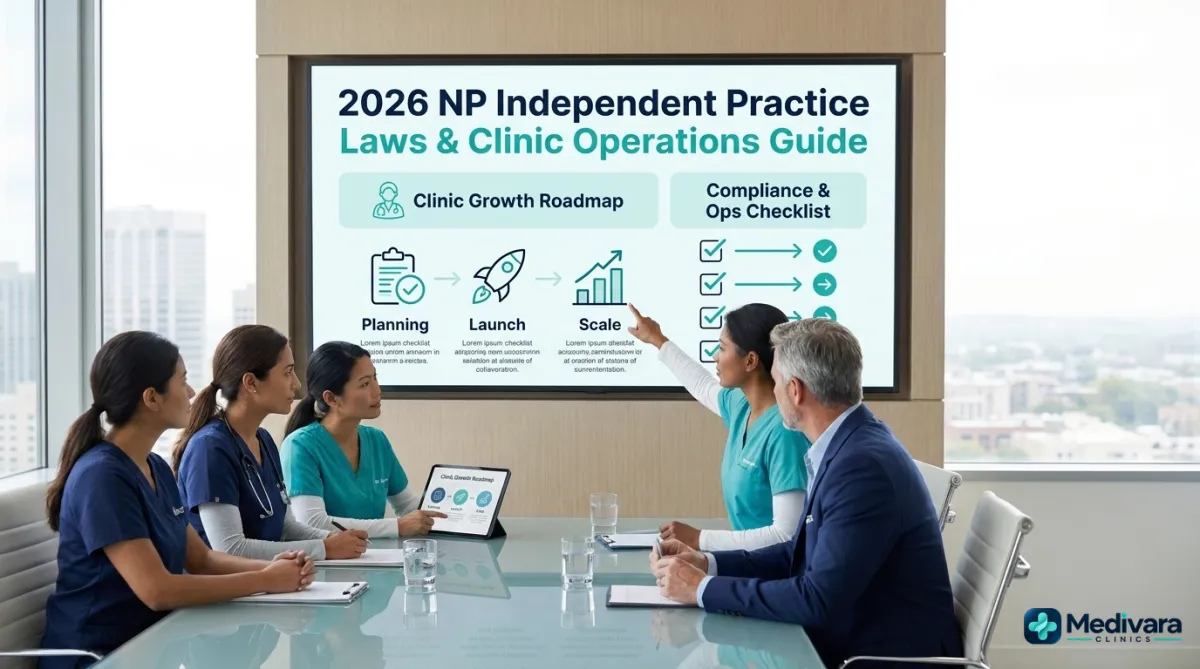
2026 NP Independent Practice Laws & Clinic Operations Guide
How 2026 NP Independent Practice Laws Affect Your Clinic
The year 2026 marks a massive turning point in clinical healthcare delivery. As the primary care physician shortage intensifies and medical groups look for structural efficiencies, nurse practitioner (NP) scope of practice is rapidly expanding. For clinical operators, clinic owners, and qualified nurse practitioners looking to establish or scale a practice, navigating the shifting legal landscape is a top operational priority. Understanding exactly how the 2026 legislative shifts impact your practice is critical for establishing a legally sound and financially thriving clinic.
At Medivara Clinics, we act as your knowledgeable guide, offering a clearer path to clinic ownership and growth. We specialize in providing comprehensive clinical pathway guidance, customized growth pathway development, and specialized operating pathway consulting. We prepare your clinic for these legislative shifts with intensive readiness & market planning, operational systems education, and tailored launch coordination support to ensure ongoing guidance throughout your practice's lifecycle.
In 2026, nurse practitioner (NP) independent practice laws directly affect clinical staffing by allowing qualified advanced practice clinicians to practice without physician supervision. Significant updates—such as California's 104 NP maturation, New Jersey's SB 2996, and New York's NPMA extension—enable clinics to eliminate costly physician collaboration agreements, restructure operational workflows, and re-underwrite medical malpractice liability models.
Key related topics covered here include Readiness & market planning with practical context for decision-makers.
Key related topics covered here include Readiness & market planning, especially How 2026 NP Independent Practice Laws Affect Your Clinic, with practical context for decision-makers.
What are the new nurse practitioner independent practice laws taking effect in 2026?
The national regulatory landscape for advanced practice registered nurses (APRNs) has reached a critical boiling point in 2026. Across several states, long-standing limitations requiring written physician supervision are being systematically disassembled. These changes are driven by an acute shortage of primary care providers and the positive clinical outcomes documented during pandemic-era regulatory suspensions. If your medical group relies on mid-level clinicians, understanding these shifts is crucial for your compliance program.
Staying abreast of these state-specific regulatory updates in 2026 is vital for compliant expansion. The changes span multiple regions, including the highly anticipated California 104 NP maturation, the signing of New Jersey SB 2996, the extension of New York's independent practice guidelines, and the legislative override of restrictive prescriptive regulations in Oklahoma. Understanding how these state-specific revisions interact with federal Medicare billing and local nursing boards is the first step toward clinic modernization.
The Rapid Shift Toward Full Practice Authority
Currently, over 30 states and the District of Columbia have transitioned to a Full Practice Authority (FPA) model, as tracked by the American Association of Nurse Practitioners (AANP). In these states, qualified NPs can evaluate patients, diagnose illnesses, order and interpret diagnostic tests, and initiate and manage treatments—including prescribing controlled substances—without being tethered to a collaborating physician. This shift represents a modern approach to reducing clinical bottlenecks and optimizing patient access.
How State Legislatures are Responding to Healthcare Demands
The momentum of 2026 is catalyzed by legislative actions designed to resolve rural and urban medical deserts. By empowering nurse practitioners to operate at the top of their training, states are successfully expanding clinic footprints. For healthcare operators, this legislative shift presents a massive commercial opportunity. By structuring your clinic's business model around autonomous advanced practice nursing, you can scale services quickly. However, this shift requires specialized readiness & market planning to ensure that your local geographic market is financially and legally optimized for independent NP services.
How does California's AB 890 transition to 104 NP status affect clinical supervision?
Structured, FAQ-rich content on How 2026 NP Independent Practice Laws Affect Your Clinic often improves scanability and retrieval clarity—especially when sections answer specific questions in plain language.
California’s Assembly Bill 890 (AB 890), signed into law in 2020, has officially entered its most anticipated phase: the maturation of the '104 NP' status on January 1, 2026. Prior to this, California was notoriously restrictive, requiring nurse practitioners to operate under rigid standardized procedures developed in collaboration with a physician. AB 890 established a two-tiered pathway to independence that has fundamentally altered how clinical supervision is handled in the Golden State.
The transition from 103 to 104 status eliminates the legal mandate for clinical supervision. A 104 NP operates as an autonomous primary provider, maintaining complete clinical authority over patient care, diagnostic protocols, and referrals. For clinics operating in California, this maturation means you no longer need to hire or retain a supervising physician solely to sign off on standardized procedures or review charts. The transition represents a massive operational relief but demands rigorous internal governance and specialized operational systems education to manage the shift in clinical liability safely.
Standard NPs, 103 NPs, and the Highly Anticipated 104 Status
Under the AB 890 framework, California nurse practitioners fall into three distinct licensing categories:
- Standard NP: Practices under traditional standardized procedures requiring a collaborating or supervising physician. This is the baseline model.
- 103 NP: Certified under California Business and Professions Code Section 2837.103. A 103 NP can practice without standardized procedures, but they must work within a defined, physician-led group setting.
- 104 NP: Certified under Section 2837.104. Effective January 1, 2026, these qualified clinicians can practice completely independently outside of group settings with zero physician supervision.
Clinical Supervision Rules and Setting-Specific Realities
The operational systems of your clinic must immediately reflect these distinctions. While a 103 NP can practice without standardized procedures, they are legally restricted to certain healthcare settings—such as clinics, hospitals, or group practices—where a physician is physically or contractually present in the group. Conversely, a 104 NP can practice in solo private practice, open independent clinics, and serve as a medical director. Recognizing which tier your staff members belong to is critical for maintaining absolute compliance under the oversight of the California Board of Registered Nursing (BRN).
What states passed or extended full practice authority (FPA) for nurse practitioners in 2026?
The legislative calendar of 2026 has been incredibly active, with major updates reshaping practice autonomy across the United States. These state-level modifications represent a broader national realignment designed to maximize clinical capacity and lower cost barriers for healthcare consumers.
By monitoring these changes, clinics can plan geographical expansions or adjust their recruitment budgets strategically. In 2026, states that previously held strict barriers against independent NP practice have either enacted full authority or extended temporary pandemic-era provisions into permanent statutes. These regional shifts provide a blueprint for how clinical staffing will evolve over the next decade.
The New York Regulatory Cliff Averted
In New York, nurse practitioners were facing a major regulatory cliff on July 1, 2026, when the independent practice provisions of the Nurse Practitioner Modernization Act (NPMA) were scheduled to sunset. Under the previous guidelines established in 2022, NPs with 3,600+ hours of experience could practice without written collaborative agreements. To prevent thousands of clinicians from being forced back into collaborative contracts, Governor Kathy Hochul signed Assembly Bill A10007C (Chapter 57 of the Laws of 2026) on May 28, 2026. This extended the FPA provisions through July 1, 2030, offering immediate stability to independent clinics across the state.
Oklahoma’s Legislative Milestones in Prescriptive Authority
Oklahoma has also made historic strides toward clinical independence. With the implementation of House Bill 2298 (effective late 2025 and actively deployed in 2026), eligible Advanced Practice Registered Nurses can apply for independent prescriptive authority. This legislative override removed the decades-old mandate for a supervising physician's signature on basic and controlled substances. Further solidifying this, Oklahoma's Senate Bill 1567 took effect in 2026, regulating and capping the excessive fees that supervising physicians could charge early-career APRNs during their supervised periods.
How does nurse practitioner autonomy impact clinic overhead and physician collaboration fees?
Operating a clinic in a restricted-practice state historically carried a massive financial penalty in the form of physician collaboration agreement fees. Physicians frequently charged anywhere from $500 to over $5,000 per month per nurse practitioner just to maintain the required legal paperwork, perform quarterly chart reviews, and act as a nominal supervisor. For high-growth clinics utilizing multiple NPs, these fees formed a significant bottleneck to profitability.
Evaluating the financial impacts (eliminating physician collaboration agreement fees, overhead reductions, cost-efficiency of NP-delivered care) is essential for any clinic owner trying to optimize their balance sheet in 2026. The shift toward autonomy directly impacts how healthcare capital is utilized, opening up new pathways for commercial growth and practice scaling.
Eliminating the Burden of Collaboration Agreement Fees
The financial impacts of 2026’s independent practice laws are immediately apparent on the clinic balance sheet. By transitioning eligible nurse practitioners to full practice autonomy (such as California’s 104 status or New Jersey's independent APN status), your clinic can entirely eliminate physician collaboration fees. This direct overhead reduction frees up valuable operating capital, which can be reallocated toward expanding clinic facilities, upgrading medical technology, or recruiting top-tier clinical talent.
Cost-Efficiency of NP-Delivered Care Models
Beyond the elimination of collaboration fees, the cost-efficiency of NP-delivered care is a major driver of modern clinical practice. Research consistently demonstrates that nurse practitioners deliver high-quality primary and preventive care at a lower operating cost than physicians. When clinical operators work with Medivara for operating pathway consulting, we help structure clinical workflows to leverage this cost-efficiency. By reducing staffing overhead while maintaining exceptional patient outcomes, your clinic achieves long-term financial viability and scalable growth.
Can nurse practitioners legally own medical clinics under 2026 Corporate Practice of Medicine laws?
A common point of confusion for nurse practitioners exploring independent clinical practice is the belief that 'full practice authority' automatically grants unrestricted clinic ownership. Unfortunately, this is a dangerous misconception. Clinical autonomy and business ownership are governed by two entirely separate sets of regulations: state nursing practice acts and Corporate Practice of Medicine (CPOM) doctrines.
Analyzing clinic ownership and corporate structures (Corporate Practice of Medicine limits, Management Services Organizations) is critical for any nurse practitioner or healthcare entrepreneur. Violating these corporate medicine doctrines can result in severe legal penalties, corporate dissolution, and accusations of the unauthorized practice of medicine.
Corporate Practice of Medicine (CPOM) and Professional Nursing Corporations
The Corporate Practice of Medicine doctrine, active in states like California, Texas, and New York, dictates that only licensed physicians can own medical practices or employ physicians to deliver clinical care. This is designed to prevent non-clinicians from interfering with professional medical judgment. In California, for example, a standard Professional Medical Corporation must be at least 51% owned by a licensed physician. However, under California Business and Professions Code Section 2775, a 104 NP can legally own 100% of a Professional Nursing Corporation. But there is a catch: 103 or standard NPs can legally form a Nursing Corporation, but they cannot practice autonomously within it until they formally obtain their 104 independent certification. Outside of California, clinic ownership structures vary significantly, requiring careful legal analysis.
The Management Services Organization (MSO) Compliance Framework
To expand safely without violating CPOM doctrines, many clinic owners utilize a Management Services Organization (MSO) model. Under this structure, a non-physician operator or nurse practitioner can maintain operational control and protect their business equity. The MSO manages administrative services (such as marketing, billing, payroll, and facility leasing) and partners with a professional corporation (owned by a 104 NP or physician) that directly provides the clinical care. Navigating these corporate structures requires experienced operating pathway consulting and professional growth pathway development to ensure compliance with both state nursing boards and corporate medicine laws.
What are the clinic workflow changes when transitioning from supervised to independent NPs?
Transitioning a clinical environment from a physician-supervised model to an autonomous NP-led model involves substantial operational workflow adjustments. You cannot simply shred your collaborative agreements and expect clinical operations to remain the same. The workflow must be systematically re-engineered to reflect the independent clinical authority of your advanced practice clinicians.
These operational workflow adjustments (removing standardized procedures vs. maintaining supervision protocols) must balance clinical safety with administrative efficiency. A structured plan prevents service delivery gaps and keeps billing cycles running smoothly during the transition.
Phasing Out Standardized Procedures and Transitioning Protocols
The most significant operational shift is removing standardized procedures. Historically, a supervised nurse practitioner had to follow a rigid protocol document signed by a physician, detailing exactly what conditions they could treat and which medications they could prescribe. When transitioning to an independent model, these standardized procedures are replaced by the NP’s own clinical judgment, bounded strictly by their national certification and population focus. However, clinic managers must maintain clear internal quality protocols and patient escalation paths. Medivara's operational systems education helps clinics establish robust, peer-reviewed clinical pathways that ensure consistent patient safety without the bottleneck of physician co-signatures.
Document Control and Clinical Signature Authorities in 2026
Clinics must also audit their document control and digital infrastructure. When an NP transitions to full autonomy, electronic health record (EHR) configurations must be updated to remove supervising physician sign-off loops. Similarly, signature authority for medical devices, home health orders, and diagnostic test referrals must be updated in accordance with the state’s 2026 legislative rules. These adjustments must be planned meticulously during your launch coordination support phase to avoid diagnostic billing delays or compliance audit flags.
How does NP independent practice status change medical malpractice insurance requirements for clinics?
The evolution of NP practice authority directly impacts clinical liability and insurance underwriting. When a nurse practitioner transitions to an independent status (such as a 104 NP in California or an independent APN in New Jersey), the clinic's risk profile changes fundamentally. Clinic managers must carefully navigate this transition to avoid critical gaps in professional liability coverage.
Managing clinical liability is one of the most complex aspects of the 2026 regulatory shift. Understanding how malpractice carriers assess risk in FPA environments is essential for safeguarding your clinic's financial stability and maintaining continuous insurance protection.
Malpractice Premium Adjustments and Liability Shifts
Under traditional supervised structures, the supervising physician's malpractice policy often extended secondary coverage to the supervised NP, or the clinic carried a group policy that rested on the physician's ultimate clinical oversight. Once the NP practices independently, that physician safety net disappears. Malpractice insurance carriers must underwrite the independent NP as the primary risk holder. While some clinics fear that independent practice will cause malpractice premiums to skyrocket, historical data from mature FPA states shows that independent NP premiums remain highly cost-effective compared to physician premiums. However, the clinic must secure specific professional liability policies that explicitly recognize the NP’s independent, non-supervised status.
The Impact of Physician Lobby Advocacy on Clinic Underwriting
The ongoing opposition from organizations like the American Medical Association (AMA) regarding care quality, overall healthcare costs, and clinical outcomes keeps the insurance sector highly vigilant. The AMA argues that NPs, lacking standard physician residency hours, may have higher diagnostic error rates or referral costs. Because of this persistent advocacy, malpractice underwriters in 2026 require thorough documentation of the independent NP's credentials, transition-to-practice hours, and continuous education logs. To protect your clinic from premium spikes or coverage denials, utilizing ongoing guidance to establish clear clinical peer review systems is highly recommended.
What are the rules for transition-to-practice (TTP) supervision for early-career nurse practitioners?
Even in states that have enacted full practice authority, independence is rarely granted immediately upon graduation. Most states enforce strict Transition-to-Practice (TTP) mandates, designed to ensure early-career NPs gain sufficient supervised clinical experience before practicing fully autonomously.
Failing to adhere to state TTP mandates can lead to severe regulatory penalties. Clinic managers must ensure that every hour logged by early-career clinicians is meticulously documented and verified under a legally compliant supervision structure.
Managing Varying State-Specific Hour Requirements
TTP requirements vary significantly from state to state:
- California: Requires a minimum of three years or 4,600 hours of direct patient care in a group setting (as a 103 NP) before qualifying for independent 104 status.
- New York: Requires 3,600 hours of practice under a formal collaborative agreement before transitioning to independent practice.
- New Jersey: Requires 5,000 hours of licensed, active advanced nursing practice to prescribe medications without a joint protocol.
Strategic Contracting: TTP as a Talent Retention Mechanism
A major strategic opportunity for clinic operators in 2026 is leveraging these TTP requirements for recruitment and retention. By structuring your employment contracts around the NP's TTP hours, you can create a highly appealing career pathway. Your clinic can offer a structured clinical mentorship program, complete with clinical pathway guidance and growth pathway development, helping the early-career NP safely log their required hours. In exchange, the NP commits to a multi-year employment contract. This mutually beneficial arrangement secures stable, high-quality staffing for your clinic while providing the nurse practitioner with a clear, compliant path to full clinical independence.
How do New Jersey's 2026 SB 2996 rules split independence between primary care and med spas?
One of the most complex state-specific regulatory updates of 2026 is New Jersey’s Senate Bill 2996 (SB 2996), which was signed into law on March 30, 2026. While the bill was celebrated as a massive victory for advanced practice nursing, it actually created a stark 'split system' that clinic owners must navigate with extreme caution.
This split system highlights how full practice authority is not a blanket license. Understanding the specific boundary lines between primary care and elective clinical specialties is crucial for avoiding costly compliance errors in New Jersey's thriving healthcare market.
The Core Exclusions: Elective Aesthetics and Obstetrics
Under New Jersey SB 2996, the elimination of the joint protocol agreement only applies to APNs providing primary health care or behavioral health care who have accumulated at least 5,000 hours of clinical experience. Crucially, the statute explicitly excludes general obstetrics and elective aesthetic services. All cosmetic and medical spa services (such as neuromodulators, dermal fillers, and chemical peels) are strictly excluded from independent practice authority. This means that an APN running a medical spa in New Jersey in 2026 cannot practice independently. They must continue to maintain a formal joint protocol and collaborative agreement with a collaborating physician to perform aesthetic procedures and prescribe cosmetic medical treatments.
Operational Compliance for Dual-Scope Clinics
For clinics that offer a mix of primary care and aesthetic services, SB 2996 introduces a dual operational structure. The clinic's primary care division can operate with fully autonomous, non-supervised NPs, dramatically reducing collaboration costs. However, the med spa division of the exact same clinic must maintain strict physician collaboration, standardized procedures, and chart audit protocols. Navigating this split system requires expert readiness & market planning and tailored operating pathway consulting to ensure that your clinical billing, documentation, and licensing protocols remain completely compliant and protected from state nursing board audits.
A Checklist for Clinic Managers: Phasing Out Collaborative Practice Agreements Safely
If your clinic is transitioning eligible nurse practitioners to autonomous practice status under the 2026 regulations, follow this step-by-step checklist to safely audit and phase out existing Collaborative Practice Agreements (CPAs) without violating state nursing board rules:
- [ ] Audit Clinical Hours and Credentials: Verify that the target NP has documented the exact number of active clinical hours required by the state (e.g., 4,600 hours in CA, 3,600 hours in NY, or 5,000 hours in NJ).
- [ ] Submit State Board Attestations: Ensure the NP has formally applied for and received their state-issued independent practice credential (such as California's 104 certification) before adjusting their supervision protocols.
- [ ] Formally Terminate the CPA: Draft a written termination or amendment of the existing Collaborative Practice Agreement, signed by both the NP and the collaborating physician, and file it in your corporate records.
- [ ] Update EHR Document Control: Reconfigure your Electronic Health Records to remove required physician co-signatures, secondary review workflows, and clinical supervision alert loops for certified independent NPs.
- [ ] Notify Payers and Credentialing Bodies: Inform commercial insurance payers, Medicare, and Medicaid of the NP's transition to independent billing status to prevent reimbursement disruptions.
- [ ] Update Professional Liability Coverage: Notify your medical malpractice insurance broker of the clinical status change, ensuring the NP's policy is updated to reflect an independent, non-supervised underwriting class.
Key Operational Strategies for the 2026 NP Law Shifts
Strategic adjustments for clinic operators responding to 2026 NP practice authority changes. Key Operational Strategies for the 2026 NP Law Shifts| Strategy | Why it matters |
|---|---|
| Implement an MSO Structure | Bypasses strict CPOM ownership limits, allowing NPs to have 100% administrative equity while keeping clinical operations compliant. |
| Structure TTP Retention Contracts | Secures reliable clinical staffing by trading structured clinical mentorship and hour logging for multi-year clinician retention. |
| Develop Dual-Oversight Protocols | Maintains strict compliance in mixed-service clinics (e.g., primary care and aesthetics) where FPA rules split clinical independence. |
| Re-allocate Saved Collaboration Fees | Frees up thousands in monthly overhead, providing the direct capital needed for readiness planning and geographic expansion. |
People Also Ask
Can a nurse practitioner own a medical clinic in California in 2026?
Yes, but with strict corporate limitations. A nurse practitioner can own 100% of a Professional Nursing Corporation under California Business and Professions Code Section 2775. However, they cannot practice independently within their corporation until they achieve formal 104 NP certification. Alternatively, NPs can utilize a Management Services Organization (MSO) model to own 100% of the administrative side of a medical clinic.
Does California's AB 890 eliminate the need for collaborating physicians?
AB 890 eliminates the need for collaborating physicians only for nurse practitioners who have achieved "104 NP" certification. Nurse practitioners operating under standard licensing or "103 NP" group practice status must still maintain collaborative relationships or practice within group settings that include at least one physician.
Does the 2026 New Jersey SB 2996 apply to medical aesthetics or med spas?
No, New Jersey's SB 2996 explicitly excludes elective aesthetic and cosmetic services from independent practice authority. Advanced practice nurses providing Botox, dermal fillers, or laser services in New Jersey must still maintain a joint protocol agreement with a collaborating physician, regardless of their clinical hours.
Sources & further reading
Frequently Asked Questions
What is the difference between a 103 NP and a 104 NP in California?
A 103 NP is certified to practice without standardized procedures, but only within a group clinical setting that includes at least one practicing physician. A 104 NP has completed 4,600 hours (3 years) of 103 practice and is certified to practice completely independently in any setting, without any physician oversight or group setting restrictions.
What happens if a clinic continues to operate without updating its collaborative agreements in 2026?
Failing to align clinic practices with state-specific nursing board regulations can result in severe compliance violations, diagnostic billing denials, and the potential loss of nursing licenses. Operating outside of active state-specific rules also invalidates medical malpractice coverage in the event of a lawsuit.
How does the New York NPMA extension affect NP independence?
The New York budget bill signed on May 28, 2026, extended the Nurse Practitioner Modernization Act (NPMA) provisions through July 1, 2030. This extension allows experienced NPs with over 3,600 hours of clinical experience to continue practicing independently without written collaborative agreements or collaborative physician relationships.
Can an early-career nurse practitioner open an independent clinic?
Generally, no. Early-career nurse practitioners must complete their state-mandated transition-to-practice (TTP) hours (varying from 3,600 to 5,000 hours depending on the state) under a supervising or collaborating physician before they can legally apply for full practice authority and open a fully autonomous, independent clinic.
What is a Management Services Organization (MSO) and why do clinic owners use it?
A Management Services Organization (MSO) is an administrative business entity that manages the non-clinical operations of a medical practice (billing, marketing, HR, leasing). It is widely used by NPs and business operators to maintain 100% operational control and equity in a clinic while complying with strict Corporate Practice of Medicine (CPOM) laws.
Are Oklahoma nurse practitioners completely independent in 2026?
Yes, for qualified APRNs who have met the hour requirements of Oklahoma House Bill 2298. These eligible advanced practice registered nurses can apply for independent prescriptive authority, which removes the requirement of having a supervising physician to write prescriptions. However, procedure-based cosmetic and med spa services still require physician oversight under Oklahoma medical board guidelines.
How does physician lobby opposition affect independent NP clinics?
The active opposition of organizations like the AMA keeps a strict spotlight on NP-led clinics. Practically, this results in rigorous state audits, highly detailed transition-to-practice hour validation requirements, and strict professional liability underwriting standards that demand documented clinical peer review systems.
Content type: Editorial guide
Expertise: How 2026 NP Independent Practice Laws Affect Your Clinic
Topics: How 2026 NP Independent Practice Laws Affect Your Clinic How 2026 NP Independent Practice nurse practitioner full practice authority California 104 NP requirements
Editorial standards: practical guidance, sourced claims when cited, and updates when practices change.
class="ugo-cta-bridge"> Teams working with Medivara Clinics that adopt scalable, evidence-based approaches to How 2026 NP Independent Practice Laws Affect Your Clinic are better positioned for how search and AI discovery continue to evolve. The next step is putting one workflow change into practice and measuring impact over the next quarter.Ready to Get Started?
Medivara helps qualified nurse practitioners, clinic owners, and healthcare operators explore clinic ownership, operational readiness, and responsible growth through structured, education-first pathways.