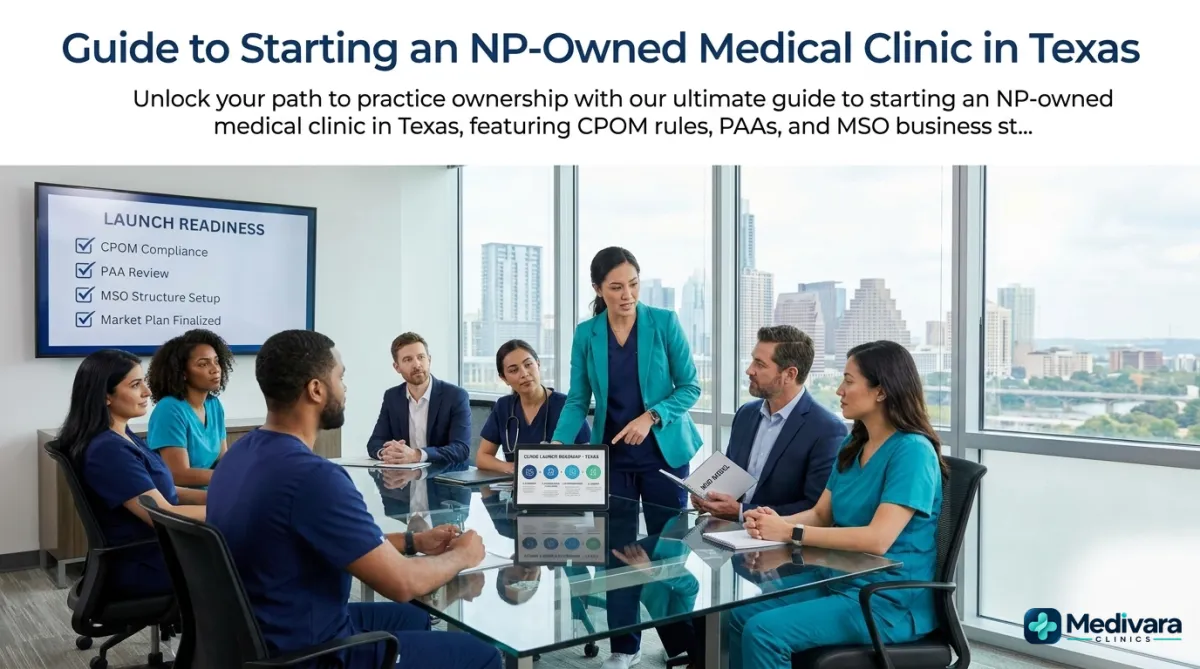
Guide to Starting an NP-Owned Medical Clinic in Texas
Transitioning from a clinical employee to an independent healthcare practice owner is one of the most rewarding milestones in a nurse practitioner’s career. For entrepreneurial nurse practitioners, the Lone Star State represents a massive, fast-growing market. However, navigating the intricate legal and operational hurdles in Texas requires highly structured planning. This comprehensive guide details the exact clinical, legal, and operational frameworks necessary to launch a successful, compliant clinic in Texas.
At Medivara Clinics, we specialize in helping qualified clinicians turn their clinical expertise into flourishing business assets. Through targeted clinical pathway guidance, robust operating pathway consulting, and complete readiness & market planning, we assist nurse practitioners in successfully mapping their journey toward independent ownership. This resource is designed to serve as your definitive regulatory playbook for starting an NP-owned clinic in Texas.
Can a nurse practitioner own a medical clinic in Texas? Yes, a nurse practitioner can legally own and operate a medical clinic in Texas. However, due to the state's strict Corporate Practice of Medicine (CPOM) doctrine, they must structure the clinic's business assets and clinical operations compliantly, which often involves establishing a Professional LLC (PLLC) for nursing services alongside a written Prescriptive Authority Agreement (PAA) with a collaborating physician.
Key related topics covered here include Readiness & market planning with practical context for decision-makers.
Key related topics covered here include Growth pathway development, Readiness & market planning with practical context for decision-makers.
When discussing this topic, Guide to Starting an NP-Owned Medical Clinic in Texas is one of the core concepts practitioners align on—this guide explains how it fits your workflow.
Is it legal for a nurse practitioner to own and operate their own medical clinic in Texas?
Direct ownership of a business entity that operates a clinical practice is entirely legal for a nurse practitioner in Texas. Under the regulations of the Texas Board of Nursing, an Advanced Practice Registered Nurse (APRN) is permitted to establish a business, lease clinical space, purchase medical equipment, and manage administrative operations. However, the exact scope of what the NP can legally perform and control within that clinic is heavily regulated by state law.
While you can fully own the business, you cannot practice "medicine" independently. Instead, you operate under scope of practice regulations and the requirement of advanced practice registered nurse (APRN) licensure. This means that while you control the business entity, any diagnostic, therapeutic, or prescribing activities must still occur under the proper legal framework of delegated authority. Ownership of the business assets does not bypass the clinical requirements mandated by the state.
Defining "Ownership" vs. "Practice of Medicine" in Texas
In Texas, a fundamental distinction is made between administrative clinic ownership and the actual practice of medicine. As an NP, your business can own the building, the brand, and the electronic health record (EHR) software. However, the legal authority to diagnose diseases and write prescriptions is a delegated medical act. Consequently, your clinic's operational systems must legally separate the business entity's activities from clinical medical decision-making.
Why APRN Licensure Determines Your Scope of Practice
Your APRN license grants you the legal authority to practice advanced nursing, but Texas remains a restricted-practice state. This means that in order to deliver primary care, specialty services, or medical aesthetics within your owned clinic, you must maintain a collaborative relationship with a licensed Texas physician. Compliance begins by ensuring your individual APRN licensure, national board certifications, and state registrations are fully active and in good standing before initiating any business filings.
How does the Texas Corporate Practice of Medicine (CPOM) doctrine affect independent nurse practitioner practice ownership?
Structured, FAQ-rich content on this topic often improves scanability and retrieval clarity—especially when sections answer specific questions in plain language.
The Texas Corporate Practice of Medicine (CPOM) doctrine and its strict limitations on non-physicians is one of the most rigorously enforced healthcare laws in the United States. Codified under the Texas Medical Practice Act, this doctrine dictates that only licensed medical doctors (MDs or DOs) can own medical practices, employ physicians to practice medicine, or directly collect professional fees generated by medical services. The core public policy goal is to prevent corporate business interests from interfering with clinical judgment.
Because nurse practitioners are not licensed physicians under the Texas Medical Board, CPOM heavily restricts how you can structure a clinic that offers comprehensive medical treatments. If your clinic provides services classified as "the practice of medicine"—which includes specialized diagnostic evaluations, complex medical treatments, and even cosmetic injectables like Botox and dermal fillers—you cannot directly employ a physician to serve under you in a standard corporate entity to delegate authority back to you.
The Strict Enforcement of CPOM in Texas
The Texas Medical Board actively investigates and penalizes structures that violate CPOM. Non-compliance can result in severe legal consequences, including heavy fines, loss of licensure for both the NP and the collaborating physician, and the invalidation of business contracts. To stay compliant, any medical services rendered in your clinic must be structured through specific legal channels that insulate clinical decision-making from business operations.
Managing the Commercial-Clinical Conflict of Interest
The primary hurdle CPOM presents to independent NPs is the clinical-commercial division. To legally operate, your clinic’s corporate structure must ensure that your collaborating physician holds complete autonomy over clinical protocols, patient charts, and medical staff supervision. Meanwhile, your business entity remains strictly responsible for the administrative, operational, and financial support services that allow the clinical side to function smoothly.
What is the difference between a Professional LLC (PLLC) and a Management Services Organization (MSO) for a Texas NP clinic?
When structuring your clinic, choosing the correct legal entity is essential for protecting your personal assets and maintaining compliance with Texas law. The two primary structures utilized by independent NPs are the Professional Limited Liability Company (PLLC) and the Management Services Organization (MSO).
A PLLC is a specialized entity type designed for licensed professionals. In Texas, a nurse practitioner can establish a PLLC explicitly to provide "professional nursing" services. This allows the NP to own the clinical entity directly, provided they only bill for and perform services within their autonomous nursing scope, supported by a Prescriptive Authority Agreement for delegated acts. However, if the practice expands into broader medical operations, specialized treatments, or medical spa services, a dual-entity MSO model is highly recommended.
The Dual-Entity "MSO and Friendly PLLC" Model
For clinics providing services that fall strictly under the "practice of medicine," the MSO model is the gold standard for compliance. Under this framework, two distinct business entities are established:
- The Clinical Entity (Friendly PLLC/PA): This professional entity is owned entirely by a Texas-licensed physician. It employs the clinical staff (including the NP), maintains patient medical records, and retains ultimate control over all clinical decisions and medical billing.
- The Management Services Organization (MSO LLC): This standard LLC is 100% owned by the nurse practitioner. The MSO owns the physical clinic building, holds the commercial lease, owns the equipment, employs the administrative staff, and handles marketing and billing systems.
The MSO and the clinical PLLC are bound together by a comprehensive Management Services Agreement (MSA). Under the MSA, the MSO provides administrative services to the clinical PLLC in exchange for a "management fee." To comply with CPOM, this fee must reflect Fair Market Value (FMV) and cannot be based on a direct percentage of medical revenues.
Comparing PLLC and MSO Clinic Structures
The following table outlines how clinical and business responsibilities are split under a compliant MSO dual-entity model versus a single nursing PLLC model:
Structural Comparison: Single Nursing PLLC vs. Dual-Entity MSO Model Summary for Guide to Starting an NP-Owned Medical Clinic in Texas| Operational Aspect | Single Nursing PLLC Model | Dual-Entity MSO Model |
|---|---|---|
| Clinical Ownership | 100% owned by the NP (restricted to nursing services) | 100% owned by a "Friendly" Physician (licensed MD/DO) |
| Business Asset Ownership | Owned directly by the NP's PLLC | 100% owned by the NP's Management Company (MSO) |
| Employment of MD/DO | Not legally permitted under CPOM rules | Physician is an owner/contractor of the Clinical PLLC |
| Prescribing Framework | Requires a direct PAA with a collaborating doctor | Physician owner delegates prescribing authority via a PAA |
| Compliance Level | Moderate (best for pure primary care/nursing) | Excellent (mandatory for med spas and complex medical clinics) |
What are the legal requirements for a Texas Prescriptive Authority Agreement (PAA) between an NP and a collaborating physician?
Because Texas does not grant full practice authority, drafting and registering Prescriptive Authority Agreements (PAAs) with a collaborating physician is a non-negotiable legal requirement for any NP-owned clinic that intends to prescribe medications or order diagnostic tests. Under Texas Occupations Code Chapter 157, a PAA is a formal, written contract where a licensed physician delegates the authority to prescribe or order drugs and medical devices to an eligible APRN.
To be legally compliant, a Texas PAA must contain several critical provisions. It must be written, dated, and signed by all participating parties. It must explicitly state the specific categories of drugs being delegated (e.g., non-controlled substances, Schedule III through V controlled substances). Additionally, the agreement must outline a structured process for sharing clinical protocols, conducting chart reviews, and maintaining regular, documented communication.
Mandatory Chart Review and Meeting Protocols
Texas law requires active, ongoing supervision as part of the PAA. A standard compliance benchmark is the 10% chart review process, where the collaborating physician regularly reviews and signs off on a sample of patient charts to ensure clinical quality. Furthermore, the NP and collaborating physician must hold regular monthly collaborative meetings to discuss patient care, clinical protocols, and operational quality. These meetings must be documented, and they can legally be held virtually via secure video conferencing.
TMB Physician Registration and Annual Re-signing
Before the NP can begin prescribing under the delegated authority, the collaborating physician must register the relationship with the Texas Medical Board. This registration links the NP's license to the delegating physician's license in the state's database. Additionally, Texas law mandates that the PAA be reviewed, updated, and re-signed by both parties at least once every 12 months (annually) to remain legally active.
Do nurse practitioners need a doctor's supervision or direct oversight to run a medical clinic in Texas?
A common source of confusion for aspiring clinic owners is whether they require "direct oversight" or on-site physician presence to keep their clinic doors open. Under Texas law, nurse practitioners do not need a physician to be physically present at the clinic site, nor do they require direct, line-of-sight supervision during daily patient encounters. The required legal relationship is collaborative, allowing the NP substantial day-to-day autonomy.
This means you can open your clinic, manage daily patient flows, perform physical examinations, formulate treatment plans, and operate your facility entirely on your own. However, you must have continuous, remote access to your collaborating physician. The physician must remain available for clinical consultations via phone, email, or telecommunication, and they must participate in the structured, retroactive quality reviews (such as chart reviews and monthly meetings) defined in your PAA.
The Nature of Remote Physician Consultation
In a modern clinical setting, remote consultation has become the standard. Your collaborating physician acts as a senior clinical consultant. If you encounter a complex patient case that falls outside your typical scope of practice or nursing experience, you must have a clear, documented protocol for contacting your collaborator to seek guidance, refer the patient, or coordinate a joint care plan.
Documenting Your Clinical Protocols
To support your day-to-day autonomy, your clinic must maintain written, evidence-based clinical protocols. These protocols act as the clinical guidelines for your practice, outlining how common conditions are diagnosed, treated, and managed. They must be reviewed and approved by your collaborating physician as part of your overall prescriptive authority agreement, establishing a clear safety net for your clinical decision-making.
Are there geographic distance or proximity limits for collaborating physicians in Texas NP clinics?
One of the most valuable regulatory updates for Texas nurse practitioners is the clarification of outdated geographic restrictions. Many competing resources and older legal articles erroneously reference a strict 75-mile distance restriction between the NP and their collaborating physician. While a 75-mile rule did exist under older regulations, modern Texas law has eliminated these site-based geographic proximity limits.
Today, there are no specific distance or geographic proximity requirements between the NP’s clinic and the primary practice location of the collaborating physician. The physician can reside and practice anywhere within the state of Texas. This regulatory shift has dramatically opened up opportunities for independent NPs, particularly those seeking to provide care in rural, underserved, or specialized markets where finding a local collaborating physician was historically difficult.
How Telehealth has Transformed Collaboration
The removal of geographic limits has paved the way for highly successful telemedicine-based collaborative models. An NP operating a clinic in El Paso or Lubbock can legally partner with a highly qualified primary care physician or specialist located in Dallas or Houston. As long as the physician is actively licensed in Texas and can participate in remote consultations, virtual monthly meetings, and electronic chart reviews, the relationship is fully compliant.
The Standard for Active Supervision
While the physical distance limit has been removed, the expectation of active, genuine supervision has not. The Texas Medical Board expects collaborating physicians to maintain a meaningful connection to the practice. If an audit occurs, the physician must be able to demonstrate that they are actively engaged in reviewing charts, providing remote clinical consultation, and holding the required monthly meetings, regardless of how many miles separate the two parties.
What is the maximum number of nurse practitioners a Texas doctor can delegate prescriptive authority to?
To prevent physicians from operating as hands-off "license-for-hire" entities, Texas enforces strict physician delegation ratio caps (maximum of 7 full-time equivalent NPs/PAs per supervising doctor, with specific exceptions). This ratio cap ensures that a collaborating physician has sufficient time and bandwidth to provide genuine, high-quality clinical oversight and support to their delegated mid-level providers.
Under Texas law, a single collaborating physician may delegate prescriptive authority to no more than seven (7) full-time equivalent (FTE) nurse practitioners or physician assistants at any given time (a 1:7 FTE ratio). It is crucial to note that this limit is measured in "full-time equivalents," meaning a physician could legally collaborate with a larger number of part-time providers, provided the combined weekly hours do not exceed the equivalent of seven 40-hour workweeks.
Understanding Strict Exceptions to the Ratio Cap
The 1:7 FTE ratio cap is strictly enforced across standard private practices, commercial clinics, and aesthetic medical spas. However, Texas law provides specific, narrow exceptions where this cap may be waived or completely removed. These exceptions include:
- Facility-Based Hospital Practices: Physicians delegating prescriptive authority within a licensed hospital setting are not subject to the 1:7 ratio limit.
- Medically Underserved Populations (MUPs): Practices located in designated Medically Underserved Areas (MUAs) or those serving designated Health Professional Shortage Areas (HPSAs) may qualify for waivers, allowing a single physician to support a larger team of advanced practice clinicians.
The Risks of Exceeding the Ratio Cap
When searching for a collaborating physician, you must perform due diligence to ensure they are not already over-allocated. If a physician signs a PAA with you but is already registered as a collaborator for 7 other FTE providers across other independent clinics, your agreement is legally invalid. This can result in an immediate suspension of your clinic's prescribing rights and exposes your business to severe compliance liability.
How do independent Texas nurse practitioners get credentialed with insurance panels and CAQH?
Unlocking reliable revenue streams for your independent practice requires establishing a rigorous, early plan for insurance credentialing and CAQH registry enrollment. Credentialing is the formal process by which insurance networks verify your education, licensure, and clinical history to authorize you to bill their panels as an in-network provider.
The foundation of the credentialing process is the Council for Affordable Quality Healthcare (CAQH) ProView database. CAQH acts as a centralized national registry where healthcare providers upload and maintain their professional credentials, including active licenses, board certifications, work history, and proof of malpractice insurance. Most major commercial insurance carriers and government programs utilize CAQH to pull provider data, making an accurate, attested profile your first operational priority.
Step-by-Step Insurance Credentialing Process
The typical timeline for completing insurance credentialing ranges from 90 to 120+ days. To avoid launch delays, you should initiate this process as soon as your legal entity is formed and your PAA is finalized. The essential steps include:
- Obtain NPI Numbers: Ensure you have your Individual National Provider Identifier (Type I NPI) and apply for a Business/Group National Provider Identifier (Type II NPI) for your new PLLC or clinical entity.
- Establish Your CAQH Profile: Complete your CAQH ProView application, upload all required clinical documentation, and complete your initial attestation. Remember to log in and re-attest every 120 days to keep your profile active.
- Secure Professional Liability Insurance: Obtain comprehensive business and individual malpractice insurance policies (such as those designed for nurse practitioner business owners through NSO). Proof of active coverage is required to submit credentialing applications.
- Submit Network Applications: Apply to major commercial insurance networks active in Texas (including Blue Cross Blue Shield of Texas, UnitedHealthcare, Aetna, Cigna, and Humana), as well as Texas Medicaid and Medicare enrollment portals.
Unique Legal Nuance: NP vs. PA Co-Ownership Laws in Texas
A critical piece of legal comparison that surprises many clinic founders is the difference in joint-venture laws between nurse practitioners and physician assistants. Under Texas Business Organizations Code § 152.0551, Physician Assistants (PAs) are explicitly granted a statutory pathway to hold a minority ownership stake (up to 49%) in a professional medical entity alongside a licensed physician.
Texas law does not extend a similar statutory joint-venture pathway to Nurse Practitioners. An NP cannot legally co-own a medical PLLC or medical Professional Association (PA) with a doctor. To build a compliant business with joint-venture partners, an NP must utilize the MSO/Friendly-PLLC model, where the NP owns 100% of the MSO, and the collaborating physician owns 100% of the clinical entity, bound together by a compliant Management Services Agreement.
What are the step-by-step business and legal requirements to open a nurse practitioner private practice in Texas?
Opening your private practice in Texas requires blending state licensing rules, legal structures, and smart operational setups. To guide your journey, our team at Medivara Clinics provides comprehensive operating pathway consulting and launch coordination support. The following structured checklist outlines the essential steps to bring your clinic from concept to reality.
Texas NP Private Practice Setup Checklist
- [ ] Conduct Readiness & Market Planning: Define your clinical specialty, target patient demographics, and perform a competitive market analysis in your chosen Texas territory.
- [ ] Establish Your Legal Entity: Register your business structure with the Texas Secretary of State. Choose between a Professional LLC (PLLC) for professional nursing services or a dual-entity MSO structure for expanded medical and aesthetic operations.
- [ ] Secure a Collaborating Physician: Partner with a Texas-licensed physician who has available bandwidth within the 1:7 FTE ratio cap and discuss competitive compensation rates (standard Texas market rates typically range from $500 to $1,500+ per month depending on clinical specialty and chart review volume).
- [ ] Draft and Sign the Prescriptive Authority Agreement (PAA): Work with legal counsel to draft a compliant, comprehensive PAA that details delegation protocols, chart review processes, and monthly meeting structures.
- [ ] Register with the Texas Medical Board: Ensure your collaborating physician registers the delegation agreement with the TMB prior to your clinical launch.
- [ ] Obtain Federal DEA and State PMP Registrations: If your clinical scope requires prescribing controlled substances, apply for your federal DEA registration and register for the Texas Prescription Monitoring Program (PMP).
- [ ] Secure Practice and Individual Insurance: Bind individual professional liability insurance and business owner's policies (such as NSO policies) to protect your operations.
- [ ] Enroll in CAQH and Begin Credentialing: Build your CAQH profile and submit credentialing applications to priority insurance networks.
- [ ] Deploy Compliant Operational Systems: Partner with Medivara for operational systems education to deploy HIPAA-compliant EHRs, practice management software, billing systems, and secure workflows.
- [ ] Execute Launch Coordination & Ongoing Growth: Utilize Medivara's structured pathways for launch coordination support and ongoing guidance to continuously scale your clinic safely and compliantly.
DEA Registration and Prescription Monitoring Program (PMP) Rules
For independent NPs prescribing controlled substances under delegated authority, compliance does not end with the PAA. You must secure an individual federal DEA registration that aligns with your collaborating physician’s protocols. Furthermore, Texas law mandates that all delegated prescribers actively query the Texas Prescription Monitoring Program (PMP) database prior to writing any prescription for opioids, benzodiazepines, barbiturates, or carisoprodol. This is a critical patient safety standard enforced by both the Board of Nursing and the Medical Board.
| Core Strategy | Why It Matters for Texas NPs |
|---|---|
| MSO Dual-Entity Structure | Separates clinical and administrative operations, ensuring compliance with strict CPOM doctrines while protecting NP business ownership. |
| Prescriptive Authority Agreement (PAA) | Mandatory written agreement that legally permits a Texas NP to prescribe under delegated physician authority. |
| Geographic Flexibility Planning | Utilizing remote collaboration to eliminate traditional proximity barriers and secure cost-effective physician oversight. |
| Operational Readiness Programs | Provides structured launch coordination, operational systems education, and ongoing growth advisory. |
People Also Ask
Can a nurse practitioner legally own 100% of a medical clinic in Texas?
Yes, a nurse practitioner can legally own 100% of a business entity, such as an MSO or a Professional LLC for nursing services, that operates a clinic in Texas. However, they cannot own the independent authority to practice medicine. Any medical services, diagnosing, or prescribing performed at that clinic must be structurally separated and delegated through a written collaborative agreement with a licensed Texas physician.
What is the penalty for violating CPOM laws in Texas?
Violating the Texas Corporate Practice of Medicine doctrine can lead to severe legal and financial penalties. The Texas Medical Board can levy heavy administrative fines, and both the nurse practitioner and the collaborating physician can face suspension or complete revocation of their professional licenses. Additionally, any contracts or business structures found in violation of CPOM are legally unenforceable in a court of law.
How much does it cost to hire a collaborating physician in Texas?
Standard Texas market rates for a collaborating physician generally range from $500 to $1,500+ per month. The exact fee varies depending on the medical specialty, the volume of patient charts requiring review, the clinical risk associated with the treatments, and whether the collaboration involves standard primary care or specialized medical aesthetic protocols.
Sources & further reading
Frequently Asked Questions
Does Texas have full practice authority for nurse practitioners?
No, Texas is a restricted-practice state for nurse practitioners. Texas law does not grant full practice authority, meaning NPs must practice under a written collaborative Prescriptive Authority Agreement (PAA) with a licensed Texas physician in order to prescribe medications and order diagnostic tests.
Do collaborating physicians have to be physically present at an NP clinic in Texas?
No, collaborating physicians do not need to be physically present or on-site at your clinic in Texas. The regulations allow for completely remote collaboration and supervision, provided the physician remains readily available for clinical consultation via phone, email, or video conferencing, and actively performs the required retroactive chart reviews.
What is the 75-mile rule, and does it still apply to Texas NPs?
The 75-mile rule was a historical geographic restriction that required a collaborating physician to practice within 75 miles of the NP's clinic. However, this restriction was completely eliminated under Senate Bill 406. Today, there are no geographic proximity limits, and your collaborating physician can be located anywhere in the state of Texas.
Can a Texas nurse practitioner own a medical spa?
Yes, a nurse practitioner can own a medical spa business in Texas. However, because aesthetic treatments like Botox, fillers, and medical lasers are legally defined as the practice of medicine, the clinic must comply with CPOM. This is achieved by utilizing the dual-entity MSO model, separating the clinical medical entity from the NP's administrative management company.
What is the maximum number of NPs a Texas doctor can collaborate with?
In Texas, a single physician can delegate prescriptive authority to a maximum of seven (7) full-time equivalent (FTE) nurse practitioners or physician assistants at one time. This 1:7 ratio cap is strictly enforced across standard private practices, though exceptions exist for facility-based hospital practices and clinics serving medically underserved areas.
Can an NP and a physician co-own a clinical PLLC in Texas?
No, Texas law does not permit nurse practitioners and physicians to co-own clinical practice entities. While Physician Assistants (PAs) are granted a statutory joint-venture pathway to own up to 49% of a practice with a doctor, NPs do not have a similar pathway and must rely on MSO structures to manage joint business ventures compliantly.
How long does the insurance credentialing process take in Texas?
The insurance credentialing and enrollment process in Texas typically takes between 90 and 120+ days. Because this timeline can delay your clinic's launch and ability to bill insurance, it is highly recommended to establish your corporate entities, CAQH profile, and PAA agreements as early as possible.
Content type: Editorial guide
Expertise: Guide to Starting an NP
Topics: Guide To Starting An NP-Owned opening a nurse practitioner practice in Texas Texas NP clinic collaborative agreement requirements corporate practice of medicine doctrine Texas nurse practitioner
Editorial standards: practical guidance, sourced claims when cited, and updates when practices change.
class="ugo-cta-bridge"> Teams working with Medivara Clinics that adopt scalable, evidence-based approaches to Guide to Starting an NP-Owned Medical Clinic in Texas are better positioned for how search and AI discovery continue to evolve. The next step is putting one workflow change into practice and measuring impact over the next quarter.Ready to Get Started?
Medivara helps qualified nurse practitioners, clinic owners, and healthcare operators explore clinic ownership, operational readiness, and responsible growth through structured, education-first pathways.