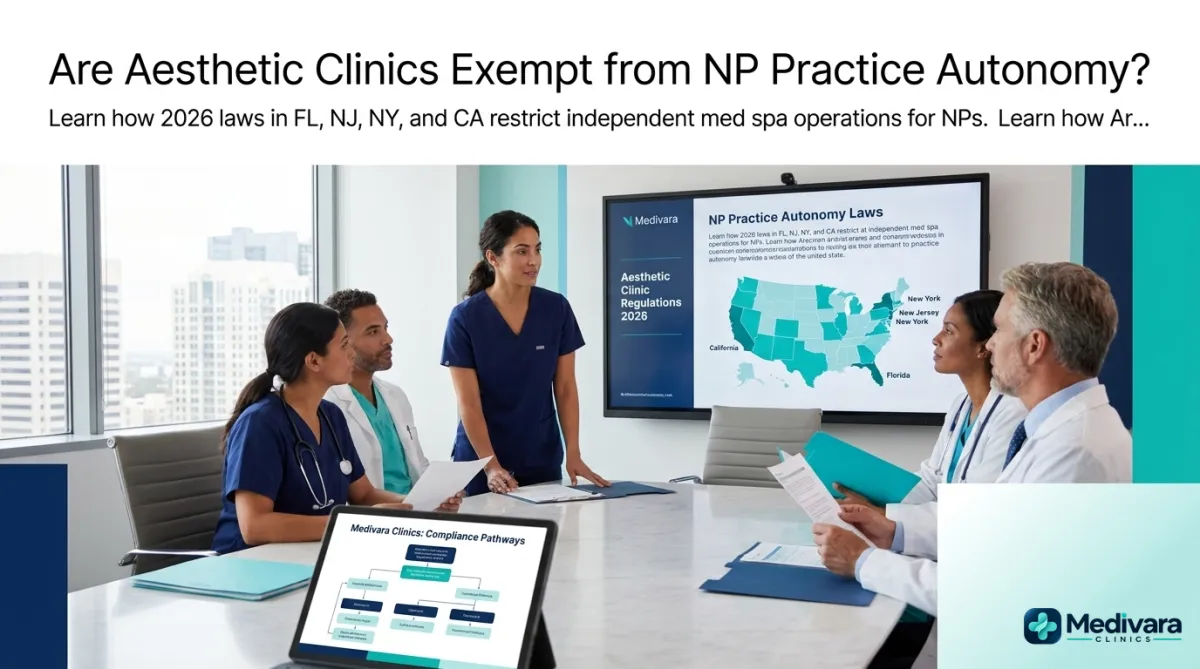
Are Aesthetic Clinics Exempt from NP Practice Autonomy?
For qualified nurse practitioners (NPs) exploring clinic ownership in cities like Phoenix, Denver, Las Vegas, Seattle, or Dallas, the dream of launching an independent medical spa is often fueled by the promise of healthcare autonomy. As of 2026, over half of U.S. states have adopted Full Practice Authority (FPA), allowing advanced practice registered nurses to evaluate patients, diagnose conditions, and prescribe medications without physician oversight. However, a critical regulatory trap awaits the unwary: Are aesthetic clinics exempt from NP practice autonomy?
Understanding this legal distinction is the difference between building a thriving, compliant business and facing devastating state board penalties. Medivara Clinics provides this comprehensive, education-first guide to help nurse practitioners, clinic owners, and healthcare operators navigate the complex intersection of clinical scope, state law, and medical-aesthetic business compliance.
Are Aesthetic Clinics Exempt from NP Practice Autonomy? Yes, in many states, aesthetic and elective cosmetic clinics are legally exempt from general nurse practitioner practice autonomy. Even within Full Practice Authority (FPA) states, laws frequently restrict autonomous practice exclusively to primary care or explicitly exclude elective cosmetic services (such as New Jersey's 2026 SB 2996 and Florida's autonomous registration statute), requiring continued physician collaboration or supervision.
Key related topics covered here include Ongoing guidance, especially Are Aesthetic Clinics Exempt from NP Practice Autonomy?, with practical context for decision-makers.
Do Nurse Practitioner Full Practice Authority (FPA) Laws Apply to Aesthetic Clinics and Med Spas?
While the nurse practitioner profession has celebrated massive legislative victories expanding clinical autonomy across the country, these laws do not automatically apply to elective aesthetic medicine. The distinction between general full practice authority (FPA) and aesthetic practice exclusions is rooted in the legislative intent behind nursing modernization. FPA laws were primarily drafted to expand access to essential healthcare and solve primary care physician shortages, particularly in rural and underserved areas.
Because injectables, chemical peels, and laser resurfacing are categorized as elective cosmetic services rather than essential primary healthcare, state legislatures and medical boards frequently carve out aesthetics from independent practice frameworks. Consequently, an NP operating in an FPA state may have the authority to manage chronic hypertension independently, yet find themselves legally restricted from administering a cosmetic neuromodulator without a collaborating physician.
Why Does Florida's Autonomous NP Practice Law (Fla. Stat. 464.0123) Exclude Aesthetic Medicine?
Structured, FAQ-rich content on Are Aesthetic Clinics Exempt from NP Practice Autonomy? often improves scanability and retrieval clarity—especially when sections answer specific questions in plain language.
Florida represents one of the most prominent examples of primary-care-only restrictions on autonomy. Passed via House Bill 607, Florida Statute 464.0123 allows qualified nurse practitioners to register as "Autonomous APRNs" after completing 3,000 clinical hours under physician supervision. This registration ostensibly eliminates the need for a supervising physician or a written protocol. However, the statute limits this independent status strictly to "primary care practice".
To prevent NPs from using this law to open independent, unsupervised med spas, Florida's regulatory framework established an explicit barrier. Under Florida Statutes 458.348 and 459.025, "practices providing primarily dermatologic and skin care services, which include aesthetic skin cares" are expressly excluded from the scope of primary care. Instead, the state classifies medical aesthetics as the "practice of medicine". This means an autonomous NP in Tampa, Orlando, or Miami cannot legally operate an independent Botox clinic under their autonomous registration; they must still maintain a formal written protocol with a collaborating physician.
How Does New Jersey's 2026 Senate Bill S2996 Limit Independent APN Cosmetic Services?
A fresh regulatory development occurred on March 30, 2026, when New Jersey Governor Mikie Sherrill signed Senate Bill S2996 (enacted as P.L.2026, c.6) into law. This highly anticipated legislation granted permanent independent practice authority to advanced practice nurses (APNs) who have completed over 5,000 practice hours, eliminating the long-standing requirement for joint protocol agreements with collaborating physicians.
However, New Jersey's 2026 SB 2996 legislative carve-out of cosmetic services created a strict boundary. The law explicitly states that independent practice authority is restricted to APNs practicing in primary care or behavioral health, and goes on to explicitly exclude "elective aesthetic services or cosmetic services". As a result, an APN delivering injectables, dermal fillers, or energy-based skin treatments in New Jersey must still operate under the state's traditional joint protocol rules, including mandatory chart reviews and physician availability. New Jersey's legislative landscape makes it undeniable: aesthetic clinics are explicitly exempt from the state's expanded nursing autonomy.
Can a Nurse Practitioner Legally Own an Aesthetic Practice or Medical Spa?
The question of whether an NP can legally own an aesthetic practice depends heavily on the state in which the clinic operates, as clinical scope of practice and business ownership laws are separate legal concepts. In states with unrestricted nursing practice and permissive business environments (such as Arizona or Colorado), an NP can legally own 100% of an aesthetic clinic and serve as its sole clinical authority. They can navigate their own launch coordination support and operating pathways independently.
However, in states with strict corporate medical rules, direct clinical ownership is prohibited for non-physicians. In these environments, NPs must utilize compliant structural workarounds to protect their investments and remain audit-ready. Medivara's Readiness & market planning services assist NPs in evaluating state-by-state viability before committing capital, aligning their business goals with compliant clinical structures.
NP Aesthetic Clinic Ownership Viability by State (2026 Data) Summary for Are Aesthetic Clinics Exempt from NP Practice Autonomy?| State Focus | Clinical Autonomy Status | Corporate Practice of Medicine (CPOM) Status | NP Ownership Viability |
|---|---|---|---|
| Arizona (Phoenix, Scottsdale) | Full Practice Authority (FPA) | No CPOM restrictions on aesthetic clinics | Yes: NPs can own 100% of the clinical entity. |
| Colorado (Denver, Colorado Springs) | Full Practice Authority (FPA) | Aesthetic clinics must align with NP FPA rules | Yes: Full independent clinical ownership is permitted. |
| Texas (Dallas-Fort Worth, Houston) | Restricted / Collaboration Mandated | Strict CPOM; only physicians can own medical PCs | No Direct Ownership: Must utilize an MSO/Friendly-PC structure. |
| Florida (Tampa, Orlando) | Restricted for aesthetics (Fla. Stat. 464.0123) | Strict; aesthetics classified as dermatology | No Direct Solo Clinical Ownership: Requires physician protocol. |
| California (Los Angeles, San Francisco) | Transitioning (104 NP status active in 2026) | Strict CPOM; NPs capped at 49% ownership of a PC | Indirect: Must utilize MSO structure to achieve 100% operational control. |
Do Aesthetic Nurse Practitioners Need a Collaborating Physician to Administer Botox and Fillers?
Botox, Dysport, and dermal fillers are classified as prescription "legend" drugs or prescription medical devices. Because of this classification, they can only be ordered, stocked, and administered pursuant to a valid medical prescription or clinical order. Whether an aesthetic NP needs a collaborating physician to execute these orders boils down to state law and the NP's clinical specialty.
In a true Full Practice Authority state (such as Washington or Oregon), an NP practicing within their certified population focus (e.g., Family Nurse Practitioner) has independent prescriptive authority. They do not require a collaborating physician to purchase or administer these drugs. However, in restricted or reduced practice states, a formal Collaborative Practice Agreement (CPA) with a licensed physician is non-negotiable. The physician must delegate the prescriptive authority to the NP, and both parties must operate under a mutually signed clinical protocol.
How Do Corporate Practice of Medicine (CPOM) Rules Impact NP Aesthetic Clinic Ownership?
The Corporate Practice of Medicine (CPOM) doctrine is a legal principle designed to protect patient safety by preventing non-physicians or commercial corporations from controlling medical decisions. Because states classify procedures like laser resurfacing, chemical peels, and cosmetic injections as the practice of medicine, aesthetic clinics are categorized as medical practices and are subject to CPOM rules.
In states with strict CPOM enforcement (such as Texas, California, and Illinois), a standard LLC owned by a nurse practitioner cannot legally operate a medical spa or directly employ medical injectors. To build a compliant business under these constraints, operators must implement the MSO/Friendly-PC model. Under this structure:
- The Management Services Organization (MSO): A business entity (often a standard LLC) owned 100% by the NP that manages all non-clinical administrative tasks, including leasing, marketing, billing, and operational systems.
- The Professional Corporation (PC): A professional medical entity owned by a licensed physician (or an NP where allowed) that employs the clinical staff, performs the medical services, and retains clinical liability.
Medivara's Growth pathway development and Operating pathway consulting help clinic owners establish legally sound, highly functional business systems that perfectly align with these MSO requirements.
What Is the Difference Between a Collaborating Physician and a Medical Director in Medical Aesthetics?
In the medical aesthetics industry, the terms "collaborating physician" and "medical director" are frequently conflated, yet they serve entirely distinct legal and operational functions. A collaborating physician is a statutory relationship required by a state's Board of Nursing to delegate prescriptive authority and define the clinical scope of a nurse practitioner. This relationship is bound by a Collaborative Practice Agreement (CPA).
Conversely, a medical director is an operational and clinical leadership role recognized primarily by the State Board of Medicine. A medical director takes responsibility for the overall clinical safety of a facility, establishes clinical protocols (SOPs), and delegates tasks to non-prescribing staff (such as Registered Nurses or estheticians). While an independent NP in an FPA state may act as their own clinical authority, they still assume the full legal duties of a medical director if they employ other staff members to administer medical treatments.
Why Did an NP-Owned Aesthetic Clinic in Iowa Face a $10,000 Fine for Voluntarily Hiring a Medical Director?
The operational danger of voluntarily adding unnecessary layers of supervision is perfectly illustrated by the 'Iowa story' regulatory trap. Iowa is a robust Full Practice Authority (FPA) state where nurse practitioners can evaluate, prescribe, and operate medical spas independently, with no physician collaboration required by law. Yet, 4Ever Young Med Spa in Waukee, Iowa—which operated with independent NPs—voluntarily hired a physician, Dr. Daniel Kollmorgen, to serve as their "Medical Director".
By voluntarily establishing a physician medical directorship, the clinic inadvertently activated the Iowa Board of Medicine's strict medical spa standards of practice (Rule 653-13.8). These rules dictate that any physician acting as a med spa medical director must remain within 60 miles of the facility and provide at least four hours per week of in-person staff supervision. Because Dr. Kollmorgen lived 80 miles away and was only physically present 2 to 3 hours per month, the Iowa Board of Medicine charged him with inadequate supervision and levied a $10,000 civil penalty in December 2025.
This cautionary tale demonstrates that adding an unnecessary medical director in an FPA state can trigger massive compliance penalties if medical board regulations are inadvertently activated. Medivara's Readiness & market planning helps independent NPs avoid this exact trap, structuring clinics to ensure maximum safety with the lowest possible regulatory burden.
What Are the Good Faith Exam (GFE) and Delegation Requirements for Aesthetic NPs?
In medical aesthetics, clinical delegation and patient assessment follow rigid medical standards. Before any medical treatment—including Botox injections, dermal fillers, IV hydration, or medical-grade chemical peels—can be performed, a qualifying provider must conduct an initial clinical assessment. This is legally known as the Good Faith Exam (GFE) or Good Faith Evaluation.
The GFE must be completed in-person or via synchronous telehealth by a licensed prescriber (such as an NP, PA, or physician) before delegating the physical administration to a Registered Nurse (RN). Because RNs lack independent prescriptive authority, they cannot legally perform GFEs, issue clinical orders, or inject cosmetic devices without a direct order from a prescriber.
Operating a med spa where RNs conduct their own exams or inject without a documented GFE is a major target for state medical board audits, often resulting in charges of practicing medicine without a license. Medivara's Operational systems education provides the framework to construct seamless, digital-first GFE workflows, keeping your clinical operations protected and compliant.
The Medivara Clinical & Growth Readiness Audit
In practice, Readiness & market planning often shapes how teams execute Are Aesthetic Clinics Exempt from NP Practice Autonomy?—this section ties that concept to actionable steps.
In practice, Readiness & market planning often shapes how teams execute Are Aesthetic Clinics Exempt from NP Practice Autonomy?—this section ties that concept to actionable steps.
In practice, Clinical pathway guidance often shapes how teams execute Are Aesthetic Clinics Exempt from NP Practice Autonomy?—this section ties that concept to actionable steps.
To ensure your med spa is fully insulated from regulatory risks, review this checklist as part of your ongoing operational pathway planning:
- Verify State-Specific Aesthetic Exclusions: Research if your state’s FPA law has active carve-outs for cosmetic and elective services (e.g., NJ SB 2996 or Fla. Stat. § 464.0123).
- Assess CPOM Compliance: Determine if your state bans corporate medicine, and establish an MSO/Friendly-PC structure if direct ownership is restricted.
- Audit the GFE Workflow: Confirm that every single patient undergoes a documented Good Faith Exam by a licensed prescriber before an RN administers any injection.
- Align Specialty with Focus: Ensure that your clinical certification matches your patient population focus (e.g., FNP or AGNP for adult aesthetic services).
- Review Collaborative Contracts: Avoid the "Iowa trap" by ensuring you do not voluntarily trigger medical board supervision rules that are legally unnecessary in your state.
| Compliance Strategy | Why It Matters |
|---|---|
| MSO/Friendly-PC Legal Structure | Bypasses strict Corporate Practice of Medicine restrictions, allowing NPs 100% operational control. |
| Airtight GFE Protocols | Insulates the clinic from medical board audits regarding illegal RN delegation. |
| Targeted Medical Directorships | Prevents unnecessary physician hiring that triggers highly restrictive, costly medical board oversight. |
People Also Ask
Can an NP run a Botox clinic without a medical director?
Yes, but only in true Full Practice Authority (FPA) states that do not enforce strict Corporate Practice of Medicine (CPOM) rules for nursing corporations (such as Arizona or Colorado). In restricted states or states with cosmetic carve-outs (like Florida or New Jersey), a collaborating physician or medical director is legally required.
Does NP full practice authority cover medical spas?
Not always. Many state FPA laws are limited exclusively to primary and behavioral healthcare (such as Florida’s HB 607 and New Jersey’s 2026 SB 2996). Elective aesthetic medicine is frequently excluded, requiring traditional joint protocols.
Do NPs need a collaborating physician to inject fillers?
In reduced or restricted practice states, yes. Dermal fillers are prescription devices that require a collaborating physician to delegate the prescriptive authority to order and administer them. Only independent, FPA-qualified NPs operating within their scope can inject without a collaborator.
Frequently Asked Questions
Are aesthetic clinics exempt from NP practice autonomy?
Yes, aesthetic clinics are frequently exempt from nurse practitioner practice autonomy. State legislatures often restrict independent practice to essential primary care or pass specific cosmetic carve-outs (like NJ SB 2996), meaning aesthetic APNs still require formal physician collaboration.
What is the 2026 New York regulatory cliff for NPs?
In 2026, New York's independent practice authority for experienced NPs (3,600+ hours) was set to sunset. However, on May 28, 2026, Governor Hochul signed an extension through July 1, 2030, preventing a disastrous reversion to mandatory written collaborative agreements.
How does California's '104 NP' status affect aesthetic clinics in 2026?
Active as of January 1, 2026, California's "104 NP" status allows qualifying NPs to practice without standardized procedures in independent medical spas. However, because California enforces strict Corporate Practice of Medicine rules, 104 NPs are still capped at 49% clinical ownership of a professional medical corporation.
What was the 'Iowa story' regulatory trap?
At a Waukee, Iowa med spa, independent NPs voluntarily hired an unnecessary medical director. Doing so activated Iowa Board of Medicine Rule 653-13.8, which requires a medical director to live within 60 miles and spend 4+ hours per week on-site. Because he failed to do so, he was fined $10,000.
Can a Registered Nurse (RN) perform a Good Faith Exam?
No. Registered Nurses do not have diagnostic or prescriptive authority. A Good Faith Exam (GFE) must be performed by a licensed prescriber (such as an NP, PA, or physician) before an RN can administer any aesthetic treatment.
What is the best business model for a med spa in a strict CPOM state?
The MSO/Friendly-PC model is the industry standard. It separates business operations (owned by the NP's MSO) from the clinical practice (owned by a physician's PC), ensuring full compliance with corporate medicine laws.
Sources
- Florida Board of Nursing - Advanced Practice Registered Nurse (APRN) Regulations
- New Jersey State Legislature - Senate Bill 2996 (2026 Session)
- Iowa Board of Medicine - Standards of Practice for Medical Directors
Content type: Editorial guide
Expertise: Are Aesthetic Clinics Exempt from NP Practice Autonomy?
Topics: Are Aesthetic Clinics Exempt from NP Practice Autonomy? Are Aesthetic Clinics Exempt From nurse practitioner med spa ownership independent NP aesthetic practice
Editorial standards: practical guidance, sourced claims when cited, and updates when practices change.
class="ugo-cta-bridge"> Teams working with Medivara Clinics that adopt scalable, evidence-based approaches to Are Aesthetic Clinics Exempt from NP Practice Autonomy? are better positioned for how search and AI discovery continue to evolve. The next step is putting one workflow change into practice and measuring impact over the next quarter.Ready to Get Started?
Medivara helps qualified nurse practitioners, clinic owners, and healthcare operators explore clinic ownership, operational readiness, and responsible growth through structured, education-first pathways.